Get consult
Unlock the secrets of the world’s most breathtaking locales with our expert insights — guiding you toward the truly remarkable destinations that define a lifetime of travel.



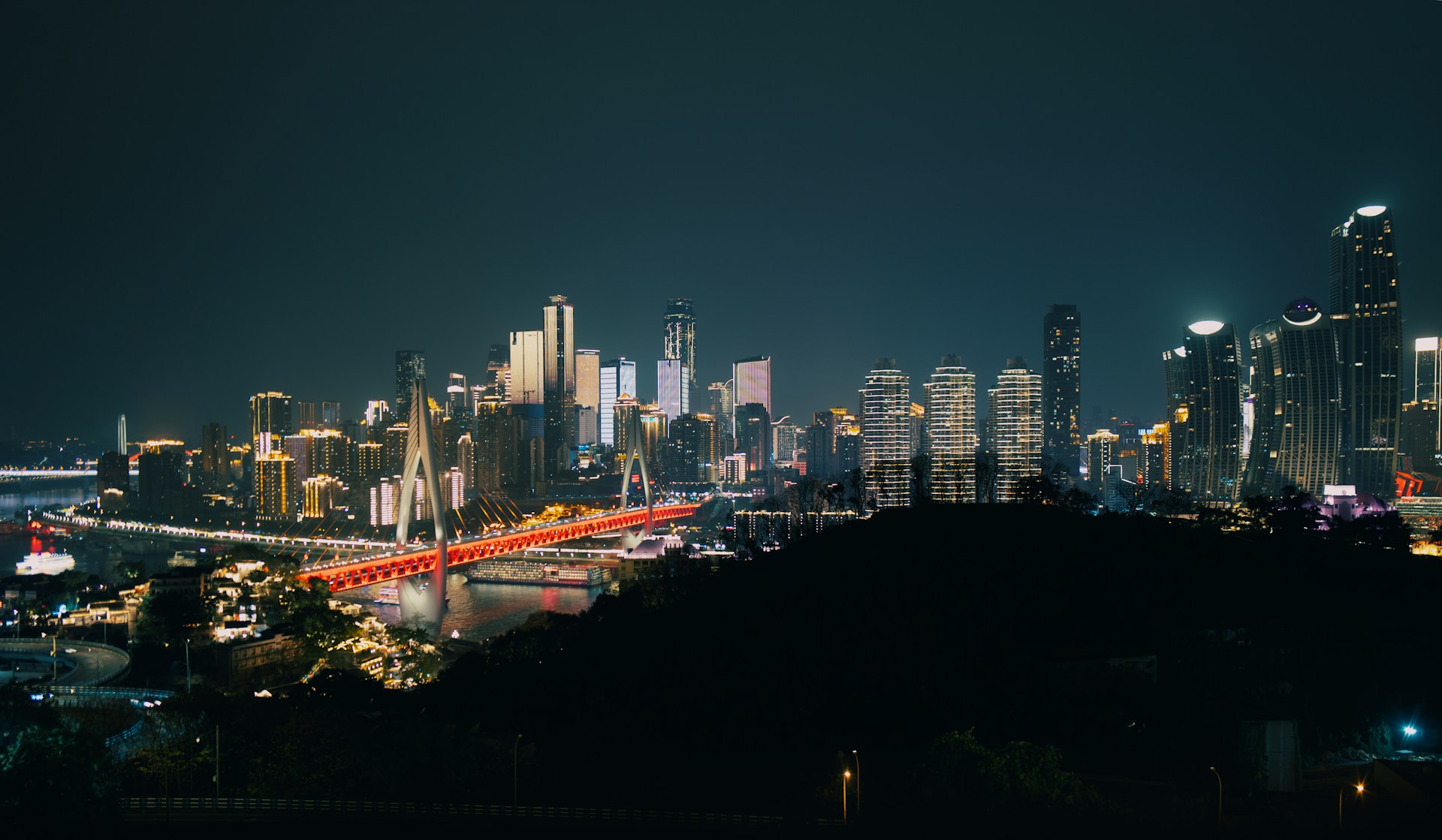
Photo by Qihao Wang on Unsplash
In early 2025, an American YouTuber named IShowSpeed broadcast a live stream to more than 10 million simultaneous viewers from the streets of Chongqing. He walked through a city where a monorail line passes directly through floors 6 to 8 of a 19-story residential building. He crossed a pedestrian bridge on the 13th floor. He ate bowl after bowl of mala spiced noodles in an alley that turned out to exist on multiple simultaneous levels of the mountain. He called it a cyber city and the internet agreed. Within days, inbound travel bookings to Chongqing through Trip.com surged 193 percent year-on-year, as confirmed by People's Daily citing Trip.com Group data. During the May Day holiday that followed, bookings continued to climb. By the end of 2025, Chongqing had recorded a 170 percent year-on-year increase in inbound foreign visitors, with hotel bookings in some commercial districts rising eightfold, according to People's Daily citing official tourism data.
Chongqing's moment is not an accident. It is the leading edge of the most significant trend reshaping inbound travel to China in 2026: Secondary City Social Media Tourism. For decades, international visitors to China followed a predictable circuit of Beijing, Shanghai, and Xi'an. That circuit is being redrawn. Foreign nationals made over 20.89 million visa-free inbound visits to China in the first three quarters of 2025, up more than 50 percent year on year, as reported by People's Daily citing National Immigration Administration data. China has extended its unilateral 30-day visa-free policy for citizens of more than 48 countries through December 31, 2026, confirmed by multiple official and news sources including China Briefing and the Chinese government's official English-language portal. Chongqing, with its impossible topography, neon-lit cliffside architecture, and food culture built around the most intense hot pot in China, is the city that a new generation of independent international travelers is discovering first.
Chongqing's significance in Chinese history long predates its current moment on international social media. The city sits at the confluence of the Yangtze and Jialing rivers in a mountainous terrain in southwest China that made it both strategically vital and architecturally extraordinary. During the Second World War, Chongqing served as the provisional capital of the Republic of China, surviving years of sustained Japanese aerial bombardment. The city's residents took shelter in an extensive network of air-raid shelters carved into the mountain rock, many of which still exist today, some converted into tea houses, bars, and mahjong halls that offer one of the most atmospherically authentic local experiences in the city.
The same mountainous geography that made Chongqing a wartime refuge is what makes it visually unlike any other megacity on earth in 2026. Because the city was built across terrain with dramatic vertical elevation changes, its buildings do not follow a flat grid. Streets at different levels intersect in ways that defy conventional spatial logic. What appears on a map as a short walk may require descending or ascending 200 vertical meters. The first floor of one building may be level with the 15th floor of the building next to it. The metro system, rather than running underground, runs on elevated tracks that weave through residential towers and above river valleys, producing a daily urban experience that travelers from flat cities find genuinely disorienting and thrilling in equal measure.
International visitors began labeling Chongqing the 8D Magic City, a term referring to the city's apparent defiance of conventional three-dimensional spatial logic. The phrase spread across TikTok, YouTube, and Douyin alongside video clips of the Liziba Station monorail passing through a residential building, of sky-high pedestrian bridges connecting buildings at floors that have no ground-level equivalent, and of the Hongya Cave complex: an 11-story stilted building structure built into a clifftop above the Jialing River that illuminates at night in a cascade of neon and lantern light so visually striking that international visitors have compared it directly to the animated cityscape from Hayao Miyazaki's Spirited Away.
In the first two months of 2025, the number of foreign nationals entering through Chongqing's ports increased by 60 percent year-on-year, as documented by CNN citing the Chongqing Immigration Administration Bureau. Data from the online travel platform Fliggy showed flight bookings from Southeast Asia to Chongqing increased more than sixfold during the Dragon Boat Festival holiday in 2025 compared to the previous year. The travel platform Klook recorded a nearly 12-fold surge in demand for Chongqing among its Southeast Asian users across 2025 compared to demand for other Chinese cities, as confirmed by CNBC citing Klook's General Manager for Indonesia, Malaysia, and Singapore.
Chongqing's viral moment would not have translated into actual visitor numbers without a concurrent transformation in China's visa landscape. The country has extended its unilateral 30-day visa-free policy for citizens of more than 48 countries, including all major EU member states, the UK, Canada, Australia, Singapore, Malaysia, Thailand, and others, through December 31, 2026, confirmed across multiple official and news sources. Canada and the UK were added to the 30-day visa-free program effective February 17, 2026. The 240-hour transit visa-free program, which allows citizens of 55 eligible countries to enter China without a visa for up to 10 days while transiting to a third country, includes Chongqing as a designated entry port, as confirmed by China Discovery. Travelers from the US who do not qualify for the 30-day program can use the 240-hour transit arrangement to access Chongqing legally, as confirmed by multiple visa guides including China Highlights and Tibet Travel.
The Chinese government has also accelerated practical accessibility: international bank card acceptance on domestic payment platforms has been expanded, instant tax refund services have been introduced at major shopping locations including Raffles City Chongqing, and bilingual service stations have been established at Chongqing Jiangbei International Airport and Chongqing North Railway Station, as documented by iChongqing's May 2025 report on the city's inbound tourism infrastructure.
Chongqing Jiangbei International Airport (CKG) is the city's main international gateway, with direct or one-stop connections from most major Asian hubs and increasing international routes. Within China, Chongqing is excellently served by high-speed rail: the city connects to Chengdu in approximately one hour and to major eastern cities via the national high-speed rail network. From Chongqing North Railway Station or Chongqing Jiangbei Station, the historic center is accessible via the city's metro. As of 2026, Chongqing's metro system has more than 13 lines. Use the Alipay app to scan QR codes at metro station gates: it works reliably for international visitors once an overseas bank card is linked, as documented by multiple 2025 and 2026 traveler guides. The ride-hailing app DiDi works for taxis and is the recommended alternative to street taxis, which require a shared-language negotiation.
Liziba Station on Metro Line 2 is where the monorail famously passes through floors 6 to 8 of a residential building. To see it properly, exit the station and find the free external viewing platform on the street below, rather than watching from inside the train. Trains pass every 2 to 4 minutes, and the visual impact from the outside observation point is significantly stronger than from inside the carriage, as documented by China Highlights' 2026 Chongqing guide. Avoid visiting on peak public holidays: crowds at the viewing platform can be overwhelming on Chinese National Day (October 1 to 7) and May Day (May 1 to 5). Weekday mornings before 9 AM offer a completely different experience.
For Hongya Cave, arrive at the Qiansimen Bridge by approximately 7:30 PM. The cave complex lights up at approximately 6:30 PM but the Qiansimen Bridge illumination turns on around 7:30 PM, and viewing both simultaneously from the bridge produces the most dramatic photography. Entry to the complex is free but requires a prior reservation through the Hongya Cave mini-program on WeChat. The address is No. 88 Jiabin Road, Yuzhong District. Take Metro Line 1 or 6 to Xiaoshizi Station (Exit 9) for the upper entrance at Cangbai Road, which connects to the 11th floor, or Line 6 to Grand Theater Station (Exit 2) for the river-level entrance at Jiabin Road. Avoid visiting on weekend evenings: traffic near Hongya Cave between 7 and 9 PM is consistently documented as severe.
Most visitors to Chongqing spend their entire time in the city center, missing one of the most remarkable UNESCO World Heritage Sites in China. The Dazu Rock Carvings, located approximately 100 kilometers northwest of the city center, are an exceptional series of rock carvings from the 9th to 13th centuries renowned for their scale, aesthetic quality, and diverse Buddhist and Taoist themes. The most significant cluster is at Baodingshan, featuring the restored Thousand-Armed Avalokitesvara. Ticket prices are available at the site and have been confirmed as approximately 125 CNY for the primary sites. Access by high-speed train from Chongqing North Station to the Dazu area is available, with the journey taking approximately 1 to 1.5 hours, as documented in multiple 2026 Chongqing guides.
Chongqing hot pot is a distinct culinary tradition from Sichuan hot pot, characterized by a deeply spiced, numbing broth using Chongqing-specific dried chili varieties and a concentrated beef tallow base. The heat and the numbing sensation from Sichuan peppercorns are genuinely intense: the experience of eating a full hot pot session here is not comparable to most diners' experience with spice. For first visits, multiple traveler guides recommend requesting a lower spice setting (slightly spicy rather than standard) and pairing the experience with cold beer. The area around Jiefangbei and Bayi Road Food Street offers a dense concentration of reliable hot pot restaurants. Ciqikou Ancient Town, a historic cobblestone riverside settlement approximately 15 to 20 minutes by metro from the city center, offers a complementary experience of old Chongqing culture alongside local snacks at more manageable prices than the tourist-facing restaurants directly adjacent to Hongya Cave.
Download Baidu Maps before arriving in Chongqing and use it for navigation rather than Google Maps, which does not function reliably in China's vertical landscape. Baidu Maps handles the city's multi-level topography significantly better and provides accurate public transit routing. For restaurant recommendations and reviews, Dianping (the Chinese equivalent of Yelp) is the most reliable local platform and requires a WeChat account to access fully. Carry a small translation app such as Google Translate (which requires a VPN to function in China) or use Microsoft Translator, which works without a VPN, for restaurant menus and street navigation. The recommended daily budget for independent travelers in Chongqing ranges from approximately 50 to 100 USD per day, as documented by Baba Goes China's 2025 travel guide, covering metro fares (approximately 2 to 10 CNY per journey), meals, and attraction entry fees.
Chongqing's viral tourism status has brought genuine pressure on its residential neighborhoods. Liziba Station sits inside a building where people live: residents on the upper floors continue to sleep, work, and go about their daily lives while tourists gather on the external viewing platform at all hours. The Chongqing government has issued public appeals to residents to accommodate visitors patiently, and during peak seasons it has sent text messages to locals asking them to allow more space for tourists. As a visitor, the reciprocal responsibility is clear. Keep noise to a minimum near the Liziba viewing platform, especially early in the morning. Do not enter residential floors of buildings that have become tourist attractions. At Hongya Cave, respect the shop owners and vendors inside: the complex is a working commercial and cultural space, not a stage set. At Manikarnika Ghat's equivalent in Chongqing terms, the ancient air-raid shelters converted into tea houses and mahjong halls, enter with genuine curiosity and order something rather than treating the space as a free photography opportunity. The residents of Chongqing have been extraordinarily welcoming to the international visitors who have arrived in their city. That hospitality deserves to be honored by traveling thoughtfully.
Kotor is a double-listed UNESCO World Heritage Site in Montenegro's fjord-like bay. Your fact-checked 2026 guide to the Adriatic's most layered medieval city and the rise of Western Balkans travel.
The Faroe Islands generated 1.4 billion DKK from tourism in 2025 while pioneering Europe's most innovative sustainable tourism model. Your fact-checked 2026 guide to the North Atlantic's most dramatic archipelago.
McMurdo Sound and the Ross Sea welcome only about 1,150 visitors per season. Your fact-checked 2026 guide to the world's most remote expedition and the huts of Scott and Shackleton.