Get consult
Unlock the secrets of the world’s most breathtaking locales with our expert insights — guiding you toward the truly remarkable destinations that define a lifetime of travel.



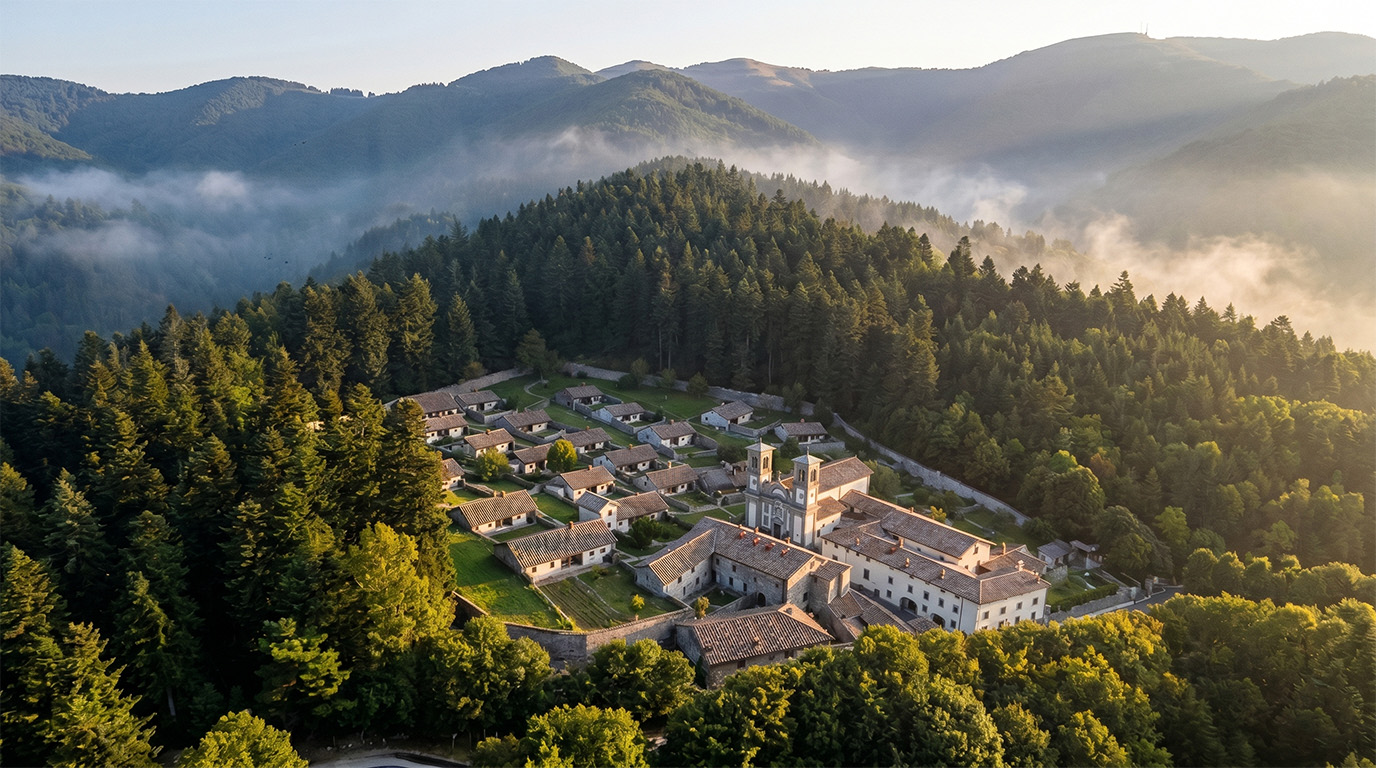
Most people who go to Tuscany go to Florence. Or Siena. Or the Val d'Orcia, the cypress-lined landscape that has become one of the most photographed places on earth. All of that is extraordinary and all of it is right. But there is another Tuscany, 50 kilometers east of Florence in the upper Arno valley of the Casentino, where the tourist trail disappears entirely, where the forest is so ancient and undisturbed that it is now recognized as one of the largest old-growth forests in Europe, and where a community of monks has been living in almost total silence in individual stone cells since the year 1012. The Eremo di Camaldoli, the Sacred Hermitage, sits at 1,100 meters in the Tuscan Apennines inside the Foreste Casentinesi National Park, and it is the kind of place that rearranges your idea of what silence actually sounds like.
The broader trend drawing travelers to Camaldoli and the Casentino valley in 2026 is Monastic Slow Tourism and Sacred Forest Immersion: a deepening interest among travelers in destinations that offer genuine withdrawal from the noise of modern life, contemplative natural environments, and the encounter with a way of living whose values run directly counter to the acceleration and connectivity that define contemporary urban existence. Italy's national tourism authority ENIT has explicitly targeted Tuscany's lesser-known valleys, including the Casentino, in its 2026 dispersal strategy away from overtouristed Florence, Siena, and the Amalfi Coast, as confirmed by Tourism Reporter International. The Casentino is, as the Florence-based tour guide collective Out of the Box Florence describes it, a Tuscany that feels completely off the tourist trail. That is both its defining characteristic and the reason 2026 is the right moment to go.
The story of Camaldoli begins with one of the most significant monastic reformers in medieval European history. Saint Romuald was born in Ravenna, Italy, around the year 951, into a noble family, as confirmed by All Saints Stories' detailed Saint Romuald biography. His early life was marked by a violent incident in which his father killed a relative in a duel: Romuald was so disturbed by what he witnessed that he entered a Benedictine monastery at Sant'Apollinare in Classe near Ravenna at the age of 20 and dedicated the remainder of his life to spiritual reform. He spent decades traveling across central Italy, visiting monasteries that had grown lax in their observance of the Rule of Saint Benedict, founding small communities of hermits in the forests and hills of the Apennines, and developing what would become the foundational rule of the Camaldolese Order: the integration of the eremitical life (the solitary hermit in his cell) with the cenobitic life (the communal monastery), as confirmed by Wikipedia's Camaldolese article and the Camaldoli Cultura official history.
Around the year 1012, Romuald arrived in the Casentino valley of eastern Tuscany, in the area of Arezzo. He was given land in the middle of an ancient forest by a local count, land that was known as Campus Maldoli: Camaldoli, from which the name derives, as confirmed by Freya's Florence Tours' Camaldoli history and the Camaldoli Cultura official records. There, he built a hermitage and then five individual cells for monks who wished to live in complete solitude, as confirmed by the Casentino Forests National Park's official Camaldoli history. The Hermitage was consecrated in 1027. Three kilometers down the mountain, a monastery was established to serve as the gateway and novitiate for the hermitage, receiving pilgrims, providing hospitality, and preparing monks for the stricter life of solitude above. Romuald's rule for the hermits was remarkably simple: silence, fasting, and life in the cell. The monastery received the Rule of Saint Benedict. The two institutions, hermitage and monastery, have functioned continuously in this relationship for more than a thousand years, as confirmed by the RITRIT Monastero di Camaldoli guide and the Camaldolese Wikipedia article.
The Camaldolese Order that grew from Camaldoli became one of the most significant monastic movements in medieval Europe. Emperors Otto III and Henry II sought Romuald's advice on religious questions. By the 13th century, the Camaldolese scriptorium in Florence had become known throughout Europe as a major source of high-quality parchments. The humanist period brought Camaldoli to prominence as an intellectual center: the so-called Camaldoli Dialogues, a famous Renaissance dialogue on humanist themes, were set here, and the hermitage attracted scholars from across Europe drawn by its combination of intellectual resources and spiritual atmosphere, as confirmed by the Italy This Way Camaldoli history documentation. In July 1943, at one of the most consequential moments of modern Italian history, the Codice di Camaldoli, an important political document outlining a Catholic vision for post-war Italian society, was drafted in the monastery, as confirmed by Wikipedia's Camaldoli article. The monastery and hermitage have survived suppressions, Napoleonic dissolution, and two world wars. Today approximately 9 monks live at the Sacred Hermitage, as confirmed by the Via di Francesco pilgrimage guide.

The Camaldoli forest is not simply the backdrop to the hermitage. It is, in a very real sense, the hermitage's most significant contribution to the world. From the earliest years of the community, the Camaldolese monks understood the forest as both a spiritual necessity and a material responsibility. Saint Romuald's requirement that the monks take the greatest care of the woods was not metaphorical: it established a formal obligation of forest stewardship that has now lasted for more than ten centuries, as confirmed by Fodor's Travel's Camaldoli guide. In the 1520 constitutions of Prior General Paolo Giustiniani, a full Forest Code was codified for the protection and management of the Camaldoli forest, one of the earliest written forest management documents in European history, as confirmed by the Camaldoli Cultura official history. The monks planted silver fir trees to replace native beech forest for timber production and for the production of lacrima d'abeto, a medicinal liqueur first recorded in 1460, as confirmed by Camaldoli Cultura. Over a millennium of continuous management by monks who understood the forest as a sacred trust rather than a resource to be extracted, the Camaldoli forest remained largely intact through the periods of industrial deforestation that stripped most of the Apennines in the 19th and 20th centuries. Today the Foreste Casentinesi National Park is recognized as one of the largest old-growth forests in Europe, with ancient silver fir and beech trees of extraordinary age and size, hosting wolves, deer, wild boar, golden eagles, and one of the most biodiverse woodland ecosystems on the Italian peninsula, as confirmed by Out of the Box Florence's expert hiking guide for 2026 and the Casentino Forests National Park's official documentation. The forest exists in this condition because monks took care of it. That is not a small thing.
Camaldoli operates as two distinct but related sites three kilometers apart on the same mountain road. The Sacro Eremo (Sacred Hermitage), at 1,100 meters, is the original and more spiritually powerful of the two: the place where Saint Romuald lived, prayed, and built the first cells. Today 9 monks live here in individual stone cottages, each with its own small walled garden, in almost complete silence, as confirmed by Fodor's Travel and the Via di Francesco guide. Three of the original cells are open to visitors, including the Cella di San Romualdo Abate, the actual cell where Saint Romuald lived, which has retained its original structure with a corridor opening onto a bedroom, study, and chapel, as confirmed by the Guida Toscana Camaldoli guide. Visitors can also see the baroque Chiesa del Sacro Eremo (1658), which contains a Bronzino altarpiece of the Crucifixion and Four Saints, and the Cappella di Sant'Antonio Abate, with an exquisite ceramic altarpiece depicting the Virgin, Child and Saints by Andrea della Robbia, as confirmed by Lonely Planet's Camaldoli guide. The dramatic Porta Speciosa, a set of black bronze doors adorned with chilling imagery, marks the main entrance to the hermit community area, as confirmed by Lonely Planet. The Monastero di Camaldoli, three kilometers below, is the more accessible and publicly oriented of the two sites, with the church containing seven panel paintings by Giorgio Vasari, and the Antica Farmacia (1450), one of the oldest operating pharmacies in Italy, whose original walnut-paneled cabinets dating to 1543 still house soaps, perfumes, cosmetics, liqueurs, and herbal remedies made by the monks, as confirmed by Lonely Planet and Visit Tuscany. A small museum adjacent to the pharmacy displays the original copper alembics, stone milling machines, and wooden hand presses used by the monks since the 15th century. A bakery opposite the monastery sells schiacciata, freshly baked Tuscan flat bread made with olive oil, and a trattoria serves regional Casentino cuisine to visitors and pilgrims, as confirmed by Lonely Planet.
Camaldoli is located in the municipality of Poppi, in the Province of Arezzo, approximately 50 kilometers east of Florence and 35 kilometers north of Arezzo, as confirmed by Out of the Box Florence's 2026 hiking guide. By car, the drive from Florence takes approximately 1 hour 10 minutes via the A1 autostrada to Arezzo and then north through the Casentino valley on the SR70, as confirmed by Out of the Box Florence. From Arezzo by car, the drive takes approximately 45 minutes north through Bibbiena and then west into the forest. There is no direct train service to Camaldoli. The nearest train station is at Poppi or Bibbiena on the Arezzo line, from which a taxi or limited local bus service connects to the Camaldoli area. In summer, buses operate as far as the Monastero; in winter, buses typically terminate at the monastery and do not continue to the hermitage, as confirmed by Italy Magazine's Camaldoli guide. A rental car from Florence or Arezzo is strongly recommended for visitors intending to explore the Casentino valley fully, including the hermitage, the monastery, the medieval castle of Poppi, and the Sanctuary of La Verna. The road from the monastery to the hermitage is a 3-kilometer drive on a narrow forest road with passing places: take it slowly and enjoy the transition from the valley to the forest. Walking the 3-kilometer path between the monastery and hermitage through the silver fir forest takes approximately one hour and is the most atmospheric way to connect the two sites, as confirmed by Out of the Box Florence and TripAdvisor visitor reviews.
The Sacro Eremo is open Monday through Saturday from 8:30 AM to 12:30 PM and from 3:00 PM to 7:00 PM, as confirmed by Italy Magazine's Camaldoli guide. It is closed on Sundays and on religious holidays during the holy harvest period. Access to the church and Saint Romualdo's cell is guided: visitors are taken in groups every 30 minutes, accompanied by a lay guide, as confirmed by TripAdvisor visitor reviews from October and November 2025. The guided visit lasts approximately 30 minutes. A small suggested donation of 2 euros is asked at entry, as confirmed by visitor reviews. Visitors can access the church, the Cappella di Sant'Antonio Abate, the Cella di San Romualdo, and the courtyard square in front of the residential wing where the 20 original hermit cells (today 9 remain) are located. The residential areas are completely off-limits: the monks live in absolute silence and complete enclosure, and no access to the inhabited cells is permitted under any circumstances. The Chapel of the Clay Pot, adjacent to the main complex, is always open and available for personal prayer and meditation, as confirmed by the Via di Francesco pilgrimage guide. The ancient library, which holds manuscripts, incunabula, and documents dating back to the 13th century, can be accessed by researchers through prior arrangement with the community, as confirmed by the Via di Francesco guide.
Both the hermitage and the monastery offer guest accommodation for those wishing to spend more than a single day at Camaldoli. The Eremo's Foresteria (guest quarters) accepts guests, including women but not children, by prior arrangement: contact the hermitage directly at eremo@camaldoli.it or by phone at 0575 556021, as confirmed by Italy Magazine. The Monastery's guesthouse at the lower site accepts families and larger groups and offers full-board stays at approximately 77 EUR per night, or 70 EUR per night for stays of multiple nights, as confirmed by the RITRIT Monastero di Camaldoli accommodation guide. Multi-day retreat courses at the monastery, covering meditation, spiritual direction, or themed workshops, run approximately 300 to 400 EUR, as confirmed by RITRIT. The atmosphere at both sites is contemplative rather than touristic: guests are expected to respect the rhythms of monastic life, attend the community's liturgical prayers if they wish, observe silence in appropriate spaces, and engage with the environment as a place of spiritual retreat rather than a hotel. Yoga and meditation sessions, including beginner and advanced classes and residential courses for deeper practice, are offered at the hermitage, as confirmed by the Via di Francesco guide. The experience of waking before dawn in the forest at 1,100 meters, hearing the bells for Vigils echo through the silver firs, and watching the Casentino valley fill with morning light below is, by any measure, one of the most atmospheric overnight experiences available in all of Tuscany.
Camaldoli is the anchor of a Casentino valley itinerary that deserves two to three days rather than a single visit. Within 30 to 40 minutes of the hermitage, the following experiences are available and should be planned in combination. The Sanctuary of La Verna, 20 kilometers southeast of Camaldoli, is where Saint Francis of Assisi received the stigmata in 1224 and is the most significant Franciscan pilgrimage site in Tuscany, as confirmed by Lonely Planet's Casentino guide. The juxtaposition of the Benedictine Camaldolese hermitage and the Franciscan sanctuary within the same forest valley, both established in the 13th century and both still active monastic communities, is one of the most remarkable concentrations of living medieval religious heritage anywhere in Europe. The Castello dei Conti Guidi in Poppi, the imposing 13th-century fortress built by the Guidi family (whose count donated the land to Saint Romuald), towers above the valley and contains a fairy-tale Gothic courtyard, as confirmed by Lonely Planet. The Parco Zoo di Poppi, adjacent to the castle, is one of the more unusual family additions to any monastic itinerary but is highly rated locally. The village of Stia at the upper end of the valley, on the banks of the infant Arno River, was historically the center of Casentino wool production and still operates small textile workshops. The valley floor between these sites is agricultural Tuscany at its quietest and greenest: organic vineyards, Chianina cattle grazing on hillside pastures, and the river winding through meadows in a landscape that Florentines have been escaping to since the Renaissance.
The best times to visit Camaldoli are late April through June and September through October: the forest is at its most vivid, temperatures at 1,100 meters are pleasant for walking (15 to 22 degrees Celsius), the forest tracks through the national park are clear and dry, and the hermitage and monastery are operating on their full visiting schedule. Summer (July through August) brings Florentine families to the Casentino in significant numbers but the forest absorbs visitors without the crowding you experience in the city: morning visits to the hermitage before 10 AM are quiet regardless of season. Autumn is the most visually spectacular season: the beech forest turns gold and amber from October, and the fir forest takes on a deeper green that is most vivid after the first rains, as confirmed by the Casentino National Park's seasonal guide. Winter reduces bus access to the hermitage, intensifies the sense of isolation, and adds snow to the forest above 800 meters from December through February, creating an extraordinary atmosphere but requiring careful road conditions checking before departure. Wear layers regardless of season: the forest is 5 to 10 degrees cooler than the valley floor. The Antica Farmacia at the monastery is open during normal visiting hours and accepts card payment: the monks' herb liqueurs, soaps, and natural remedies make the most directly sourced souvenirs available anywhere in Tuscany. No large-scale ATM access exists in the Camaldoli area: carry cash from Poppi or Bibbiena for any purchases at smaller local establishments.
Camaldoli is not a heritage attraction. It is an active monastic community that has accepted, since Saint Romuald's original design, a responsibility to welcome pilgrims and guests while protecting the conditions that make its contemplative life possible. The monks who live in silence at the hermitage above are not historical re-enactors. They are people who have made a specific and demanding choice to dedicate their lives to prayer, solitude, and the care of the forest. Visiting their community is a privilege, not a right, and the conditions of that visit, the guided access, the silence required in certain spaces, the complete prohibition on entering the inhabited areas, are not bureaucratic restrictions but the minimum conditions for the monks' way of life to continue.
Keep your voice low throughout the hermitage complex even in the areas open to visitors. Switch mobile phones to silent before entering the gates and avoid making calls anywhere within the complex. Do not photograph the monks. Do not photograph the inhabited cell area even from the exterior: the courtyard facing the cells is visible from the visitor path, and pointing a camera at it is an intrusion on the silence the monks have chosen. Photograph the church, the art, the forest, and the extraordinary views. The forest of the Casentino is a protected national park: stay on marked trails, carry your waste out, and treat the ecosystem with the same care the monks have brought to it for ten centuries. The ancient silver firs you are walking among are the living result of a thousand-year conservation commitment. They deserve the respect that fact implies.
Kotor is a double-listed UNESCO World Heritage Site in Montenegro's fjord-like bay. Your fact-checked 2026 guide to the Adriatic's most layered medieval city and the rise of Western Balkans travel.
The Faroe Islands generated 1.4 billion DKK from tourism in 2025 while pioneering Europe's most innovative sustainable tourism model. Your fact-checked 2026 guide to the North Atlantic's most dramatic archipelago.
McMurdo Sound and the Ross Sea welcome only about 1,150 visitors per season. Your fact-checked 2026 guide to the world's most remote expedition and the huts of Scott and Shackleton.