Get consult
Unlock the secrets of the world’s most breathtaking locales with our expert insights — guiding you toward the truly remarkable destinations that define a lifetime of travel.



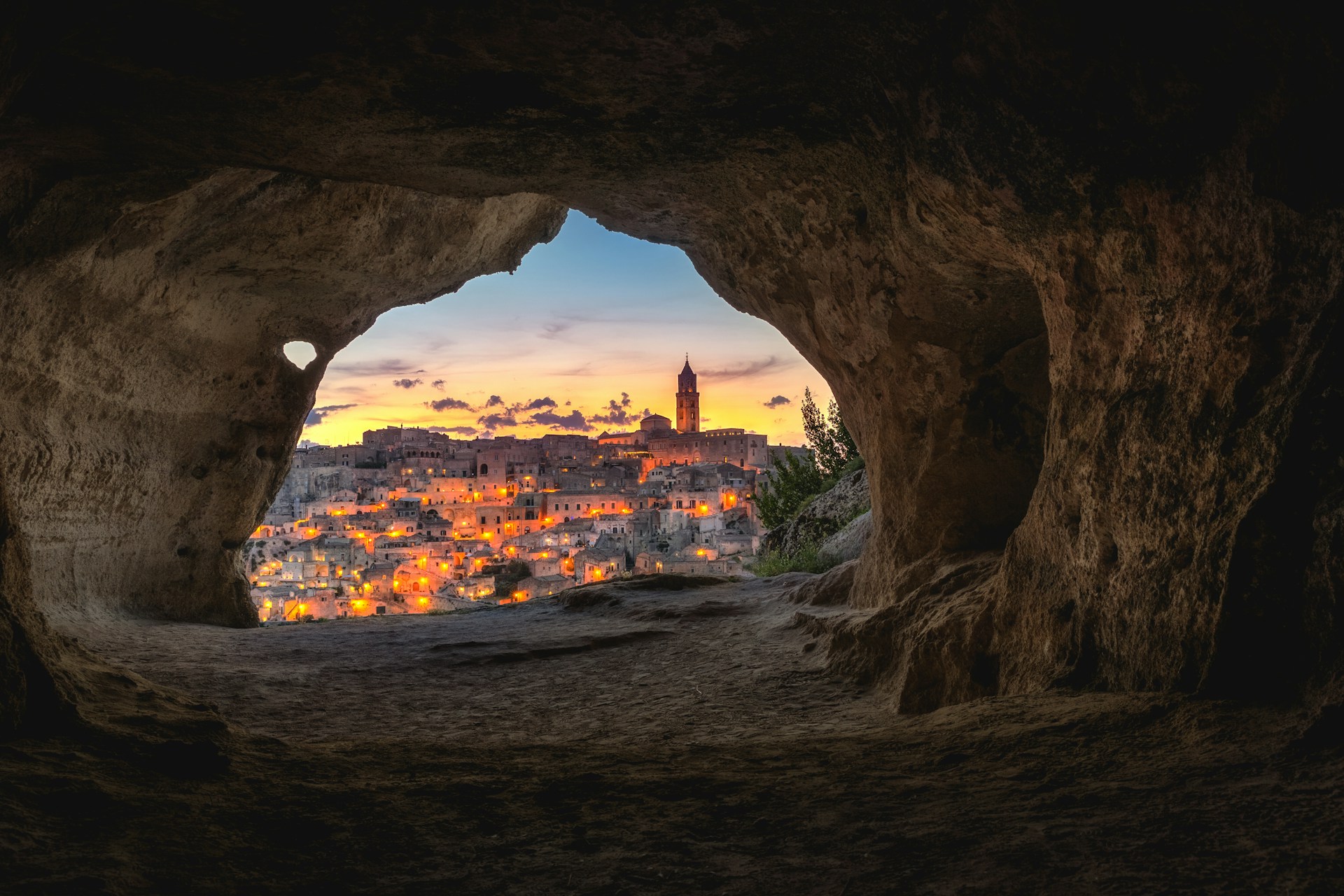
Photo by Luca Micheli on Unsplash
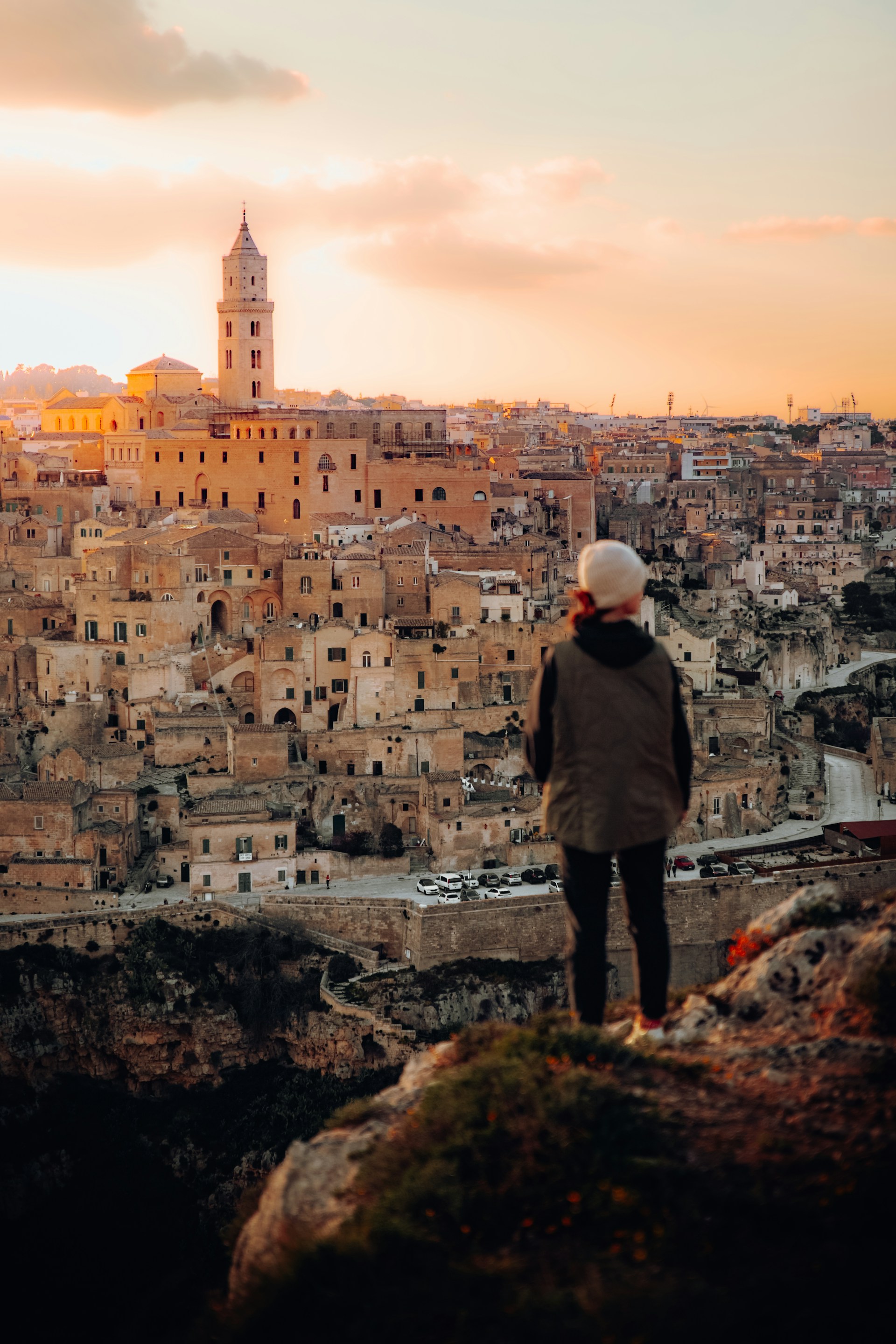
There is a moment that happens to nearly every visitor who stands at the edge of the Belvedere viewpoint and looks across the Gravina gorge at Matera for the first time. The city is there on the opposite cliff face, thousands of cave dwellings and rock churches stacked on top of each other in tiered descent toward the ravine below, the golden tufa limestone glowing amber in the late afternoon light, and the mind simply cannot reconcile what the eyes are seeing with anything it has encountered before. This is not a ruined city. It is not a museum reconstruction. People have been living in these caves, on this cliff, in this exact place, for more than 9,000 years. You are looking at the oldest continuously inhabited urban settlement in Europe.
Italy welcomed 185 million tourists in 2025, a 7.1 percent increase compared with 2024, as confirmed by the Italian Ministry of Tourism cited by Tourist Italy's 2025 to 2026 annual review. Within that national boom, Basilicata grew 7 percent in the first nine months of 2025, one of the strongest growth rates of any Italian region, as confirmed by FIRSTonline citing Italy's tourism balance of payments data. Matera specifically recorded approximately 600,000 UNESCO site visitors in recent years, as confirmed by the Gitnux Italy Tourism Statistics 2026 report. ENIT (Italy's national tourism authority) has made Basilicata and Matera explicit priority destinations in its 2026 strategy, actively directing traffic away from overtouristed Rome, Venice, and Florence toward authentic southern Italian experiences, as confirmed by Tourism Reporter International citing ENIT President Alessandra Priante's official announcement. The first Sunday of every month, state museums and archaeological sites including the Matera caves are free to visit, as confirmed by Tourism Reporter International. The trend that defines Matera in 2026 is Slow Heritage Tourism and the Rise of Southern Italy's Ancient Cave Culture: a deepening traveler recognition that the most extraordinary human story in Italy is not in its Renaissance palaces or Roman forums but in a cliff-face settlement in Basilicata where civilization never stopped.
Matera's history begins in the Palaeolithic era. The natural caves of the Murgia plateau, exposed as the Gravina river cut its limestone gorge over millions of years, attracted the first human inhabitants approximately 9,000 years ago, making Matera one of the world's oldest continuously inhabited settlements, predating cities like Jerusalem and Damascus, as confirmed by the UNESCO World Heritage Centre's official Matera listing and the Sassi di Matera heritage documentation. By the Neolithic period, a complex of permanent cave settlements had developed along the gorge walls. During Greek and Roman periods, the cave openings began to be closed with masonry facades, evolving from simple shelters into the layered, interconnected cave houses that define the Sassi today. A Romanesque cathedral was built on the highest point, the Civita, in the 13th century, creating the visual anchor of the cityscape that still dominates the skyline.
The Sassi districts, Sasso Barisano to the northwest and Sasso Caveoso to the south, grew organically over centuries into one of the most extraordinary urban environments ever created: a three-dimensional labyrinth where the roof of one dwelling forms the street or courtyard of the dwelling above, cisterns collect rainwater through terracotta channels, and more than 150 rock churches are carved into the cliff face, their interior walls decorated with Byzantine frescoes that have survived for centuries in the cool, stable cave climate, as confirmed by multiple heritage and travel sources. The cave dwellings, called case grotta, feature barrel-vaulted ceilings, natural ventilation carved through the rock, and multi-level interiors that illustrate a sophisticated adaptation to the limestone environment developed and refined over 9,000 years of continuous occupation, as confirmed by the ad-hoc-news.de Sassi di Matera heritage documentation.
By the 1950s, the Sassi had become severely overcrowded. Tens of thousands of people, often large families sharing single cave rooms with their livestock, lived without running water, sewers, or electricity in conditions that writer Carlo Levi documented in his 1945 memoir Christ Stopped at Eboli, which shocked the world and led Matera to be called the Shame of Italy, as confirmed by the Travel Bunny and Italy Travel Net historical accounts. Prime Minister Alcide De Gasperi visited in 1950 and was so appalled by the conditions that the Italian government mandated the forced relocation of the entire Sassi population to new public housing in the modern upper town, a process completed during the 1950s and 1960s. The historic districts were abandoned for decades, falling into disrepair. UNESCO inscribed the Sassi and the Park of the Rupestrian Churches of Matera as a World Heritage Site in 1993, the first site in southern Italy to receive this designation, recognizing them as the most outstanding intact example of a troglodyte settlement in the Mediterranean region, perfectly adapted to its terrain and ecosystem, as confirmed by the UNESCO World Heritage Centre's official Matera listing. The designation triggered a dramatic reversal: investment, restoration, and international attention began transforming the abandoned Sassi into the extraordinary cultural destination visible today. In 2014, Matera was designated European Capital of Culture for 2019, further accelerating infrastructure investment and cementing its transformation from shame to symbol, as confirmed by Wikipedia's Matera article and multiple heritage sources.
Matera's visual resemblance to biblical-era Jerusalem is so striking that filmmakers have used it repeatedly as a location for major religious and epic productions. Mel Gibson filmed significant portions of The Passion of the Christ in Matera in 2004, and the city has also served as a location for multiple other international productions, as confirmed by Wikipedia's Sassi di Matera article and the Italy Travel Net heritage guide. The rupestrian churches carved into the cliff face throughout the Sassi districts are among the most remarkable early Christian monuments in southern Italy: over 150 rock churches exist within the Matera UNESCO property, many containing well-preserved Byzantine frescoes in vivid pigments that have endured for centuries in the stable cave environment, as confirmed by the Matera history documentation on tourismattractions.net. The Crypt of the Original Sin (Cripta del Peccato Originale), located outside the city proper near Pietrapentrata, contains what are considered among the most significant early medieval frescoes in southern Italy, dating to the 8th or 9th century and depicting the story of Genesis in vivid ochre, terracotta, and blue pigments across a cave ceiling, as confirmed by the Go Ask A Local guide and multiple Matera heritage sources. It requires a short drive from the city center but is considered an essential companion experience to the Sassi visit.
Beneath Piazza Vittorio Veneto, the main square of the modern upper town, lies one of the most remarkable pieces of urban engineering in medieval southern Italy: the Palombaro Lungo, a massive underground cistern built in 1832 with stone pillars carved from the bedrock supporting a barrel-vaulted ceiling more than 15 meters high, navigable by boat, as confirmed by Wikipedia's Matera article. The cistern was the primary water collection system for the upper city, channeling filtered rainwater from the piazza above through a sophisticated gravity-fed system. It was rediscovered and opened to the public after restoration, and guided tours descend into the underground chamber for one of the most dramatically atmospheric experiences in the entire city. This is not a minor attraction: it is a direct encounter with the engineering ingenuity that allowed a civilization to survive in a waterless limestone plateau for nine millennia.
Matera has no airport and no direct high-speed rail connection. The correct approach for international travelers is to fly into Bari Karol Wojtyła Airport (BRI) in neighboring Puglia, approximately 65 kilometers from Matera and reachable in under an hour by car or direct shuttle bus, as confirmed by Go Ask A Local's Matera guide and the visititaly.eu transport guide. Direct shuttle buses depart from Bari Airport to Matera daily, making this the simplest connection for most visitors. From Bari city center, FlixBus and MarinoBus offer direct bus services to Matera taking approximately 1 hour 15 minutes with tickets starting from around 9 EUR, as confirmed by visititaly.eu. From Naples, direct buses via FlixBus, MarinoBus, and Itabus operate to Matera taking approximately 3 hours 45 minutes with tickets from around 10 to 35 USD, as confirmed by Rome2Rio's Naples to Matera transport guide. From Rome, the journey is approximately 6.5 hours by bus or train with connection, making Matera a destination requiring at minimum an overnight stay: do not attempt a day trip from Rome, as confirmed by A Passion and A Passport's Matera itinerary guide. Matera is approximately 400 kilometers from Rome, 650 kilometers from Florence, and 850 kilometers from Venice, as confirmed by A Passion and A Passport. By car, the freedom to explore Matera and the surrounding Basilicata and Puglia region is significantly enhanced: the drive from Bari airport to Matera along the SS96 takes approximately one hour, and a rental car opens up the Murgia Materana National Park, the Crypt of the Original Sin, and nearby Alberobello and Altamura as natural companion stops.
Staying inside the Sassi districts rather than in the modern upper town is the single most impactful decision you will make for your Matera visit. The experience of waking up in a cave hotel, stepping onto a stone terrace carved from a 9,000-year-old cliff face, and watching the Gravina gorge fill with early morning light cannot be replicated from a standard hotel room on the upper street level. Cave hotels in Matera span a full spectrum: dorm beds in atmospheric cave hostels start at approximately 20 to 35 EUR per night, boutique cave hotels in the mid-range run 100 to 200 EUR per night, and luxury cave hotels with spa facilities, hot tubs, and private terraces can reach several hundred EUR per night, as confirmed by the Matera City Guide on takeyourbackpack.com and the Mamma Mia Indeed Matera guide. Book well in advance during peak season (April through October) as the best properties fill months ahead. If you arrive by bus rather than car, prioritize Sassi district accommodation without hesitation: dragging luggage through the steep stairs and cobblestones of the Sassi on arrival is worth every step of it, as confirmed by the Big World Small Pockets Matera budget guide. The Sassi get very dark after sunset: use this as a feature, not a bug. The cave alleys and church facades illuminated only by stone lanterns and moonlight are among the most atmospheric night-time experiences in Italy.
The Sassi divide into two distinct neighborhoods. Sasso Barisano, to the northwest, is the busier, more commercial district: most souvenir shops, cafes, gelaterias, and casual restaurants are concentrated here, as are the majority of cave hotels. It is the natural arrival point for most visitors. Sasso Caveoso, to the south, is the quieter and more atmospheric district: its arrangement of cave dwellings descending in tiers toward the gorge resembles a theatre carved from the cliff, and its viewpoints across to the Murgia plateau and the wild opposite gorge wall deliver the most dramatic panoramas in the city. The essential experiences across both districts include: the Casa Noha museum in Sasso Caveoso, which screens a 30-minute documentary providing essential historical context before you explore the Sassi in depth; the viewpoints along the Belvedere terrace for sunrise and sunset (free, no booking required); the rupestrian churches scattered throughout both districts, many open for independent entry; the Palombaro Lungo cistern beneath Piazza Vittorio Veneto; and a guided walking tour with a local guide, which dramatically increases the depth of what you understand and see, as confirmed by the Travel Bunny's Matera guide and Big World Small Pockets. Wear shoes with grip: the Sassi are an uneven labyrinth of limestone steps, cobblestones, and stone slopes that are slippery when wet and demanding on ankles regardless of conditions, as confirmed by multiple visitor guides. The city is best explored early morning before 9 AM when the light on the tufa stone is at its most beautiful and the alleys are still quiet, and again at dusk when the stone glows amber and the lanterns begin to glow.
Parco della Murgia Materana on the opposite side of the Gravina gorge from the city is the natural continuation of any Matera experience. The plateau above the opposite gorge wall contains the oldest cave dwellings in the Matera area, predating those of the Sassi, along with wild rupestrian churches accessible only on foot or by mountain bike, and panoramic viewpoints from which the entire Sassi cityscape is visible in one extraordinary sweep, as confirmed by the Go Ask A Local Matera guide and the Mamma Mia Indeed guide. The park is accessible by a hiking trail from the gorge floor, crossable via a suspension bridge, making a half-day gorge crossing and park hike one of the most rewarding physical experiences available in southern Italy. Alternatively, the park can be reached by car via a road that loops around the gorge from the city: hire a local guide or join an organized hiking or e-biking tour for the most complete experience, as confirmed by multiple 2026 Matera visitor guides.
The best months to visit Matera are April through June and September through October: the light on the tufa limestone is at its most vivid, temperatures are ideal for walking the Sassi (20 to 28 degrees Celsius), and crowds are manageable relative to the July and August peak, as confirmed by the Go Ask A Local guide and multiple 2026 Matera visitor sources. July and August bring maximum heat (regularly exceeding 35 degrees Celsius on the exposed limestone terrace) and the highest visitor volumes, though Matera remains significantly less crowded than Rome, Florence, or the Amalfi Coast even at peak. November through March offers the quietest experience, occasional cold temperatures, and the best availability of cave hotels at their lowest prices, with the added drama of mist settling in the Gravina gorge. Budget expectations in 2026: Matera is more expensive than many southern Italian cities but more affordable than the major northern tourist centers. Expect approximately 80 to 150 EUR per person per day for a comfortable mid-range experience covering cave accommodation at the budget end, meals at local trattorias, and entry to paid sites. Lucanian cuisine, the regional food tradition of Basilicata, is one of the finest and most underappreciated in Italy: cruschi (dried sweet peppers fried in olive oil, a Basilicata signature), peperoni cruschi pasta, lagane e ceci (homemade pasta with chickpeas), Matera bread (Pane di Matera, a large sourdough loaf with a hard crust and dense crumb baked in wood-fired stone ovens, awarded PGI protected geographic indication status), and Aglianico del Vulture, Basilicata's extraordinary volcanic wine, are the essential food and drink experiences of a Matera visit, as confirmed by multiple Basilicata food guides. Eating at a trattoria in the Sassi itself, with a glass of Aglianico and a view across the gorge, is as good as Italian dining gets anywhere in the country.
Matera is not a heritage park. It is a living city with a population of approximately 60,000 people whose relationship with the Sassi is complicated by a history that includes forced eviction, shame, abandonment, recovery, and now the pressure of tourism success. The residents who were forcibly relocated from the Sassi by the Italian government in the 1950s and 1960s did not all experience this as liberation: for many families, it was displacement from ancestral homes whose roots went back generations. The Sassi today are primarily occupied by hotels, restaurants, shops, and cultural spaces rather than by permanent residents: the community that once filled these caves with daily life now occupies the modern upper town and looks down at its ancestral neighborhood as a cultural destination.
Visiting responsibly means engaging with that layered reality rather than treating the Sassi as a photogenic backdrop. Choose locally owned cave hotels, restaurants, and tour operators. Hire a local guide rather than following a generic audio tour: the difference in what you understand about the city is significant, and the economic benefit goes directly to a Materano rather than a platform. The rupestrian churches, many of which contain irreplaceable Byzantine frescoes, deserve the same respect you would extend to any active place of worship: enter quietly, do not touch the walls or frescoes, and photograph without flash. The UNESCO World Heritage listing that transformed Matera's fortunes imposes a specific obligation on every visitor: the site is inscribed because it is considered of outstanding universal value to all of humanity. Treat it accordingly. The 9,000 years of civilization embedded in these stones represent the longest unbroken record of human presence in any European city. That deserves more than a selfie.
Kotor is a double-listed UNESCO World Heritage Site in Montenegro's fjord-like bay. Your fact-checked 2026 guide to the Adriatic's most layered medieval city and the rise of Western Balkans travel.
The Faroe Islands generated 1.4 billion DKK from tourism in 2025 while pioneering Europe's most innovative sustainable tourism model. Your fact-checked 2026 guide to the North Atlantic's most dramatic archipelago.
McMurdo Sound and the Ross Sea welcome only about 1,150 visitors per season. Your fact-checked 2026 guide to the world's most remote expedition and the huts of Scott and Shackleton.