

Get consult
Unlock the secrets of the world’s most breathtaking locales with our expert insights — guiding you toward the truly remarkable destinations that define a lifetime of travel.


South Korea has become one of the fastest-growing tourism destinations on the planet. According to analysis by InsideAsia Tours, booking interest for Korea grew significantly in 2024 and continued surging through 2025, fueled by what the industry calls the hallyu wave: the global spread of K-pop, K-drama, Korean cuisine, and Korean beauty culture that has turned millions of international fans into actual travelers. As reported by Yahoo News and CNN in 2025, since the premiere of the Netflix smash hit KPop Demon Hunters in June 2025, now described as the most-watched film in Netflix history, booking platforms recorded a massive spike in flight sales to South Korea.
But here is where it gets interesting. While 77.3% of travelers to Korea head directly to Seoul, according to 2025 settlement data from South Korea's Ministry of Culture, Sports and Tourism cited by KCulture.com, a quiet but powerful secondary wave is building. Travelers who have already done Seoul are asking a harder question: where does the real Korea live? For a growing number of them, the answer is Jeonju.
The modern trend driving Jeonju's rise is K-Culture Secondary City Exploration: the shift from Seoul-centric Korean tourism toward provincial cities that hold the cultural, culinary, and historical foundations that K-culture itself draws from. As Travel and Tour World reported in September 2025, the South Korean government has launched the K-Culture Powerhouse Global Tourist Attraction Campaign, which explicitly connects Seoul, Jeonju, and other provincial cities into a single cultural tourism network designed for international visitors.
Jeonju is the cultural capital of Jeonbuk State and the ancestral home of the Yi family, the royal clan that ruled the Joseon Dynasty for more than 500 years. The city has always held deep significance in Korean cultural identity. But its international tourism profile has evolved rapidly over the past three years, driven by three converging forces.
Jeonju holds the distinction of being Korea's first UNESCO Creative City of Gastronomy, a designation confirmed by the Korea Tourism Organization (KTO) on its official Visit Korea platform. This recognition formalizes what locals have long known: the Jeolla region produces the most celebrated food culture in all of Korea, and Jeonju sits at its center. The Jeonju version of bibimbap, the rice-and-vegetable dish that has become a global symbol of Korean cuisine, uses a diverse harmony of five-colored ingredients representing five elements of the universe, as documented by Stripes Korea. The local saying, eat once in Jeonju and be spoiled for life, is cited by InsideAsia Tours as the defining claim of the city's culinary identity.
Jeonju Hanok Village has become a pilgrimage site for K-drama fans. According to the Korea Tourism Organization's official Visit Korea platform (last updated July 2025), filming locations within the city include the globally popular K-drama Twenty-Five Twenty-One (2022), Our Beloved Summer (2021), and the Oscar-winning film Parasite (2019). The Jeonju Traditional Liquor Museum is specifically noted by KTO as a K-culture landmark because of BTS's visit, where the group made their own makgeolli (traditional rice wine). The 2026 K World Dream Awards, described by Travel and Tour World as drawing over 90% international audiences and being scheduled for August 2026, further positions Korea's provincial cultural cities as fan destination anchors.
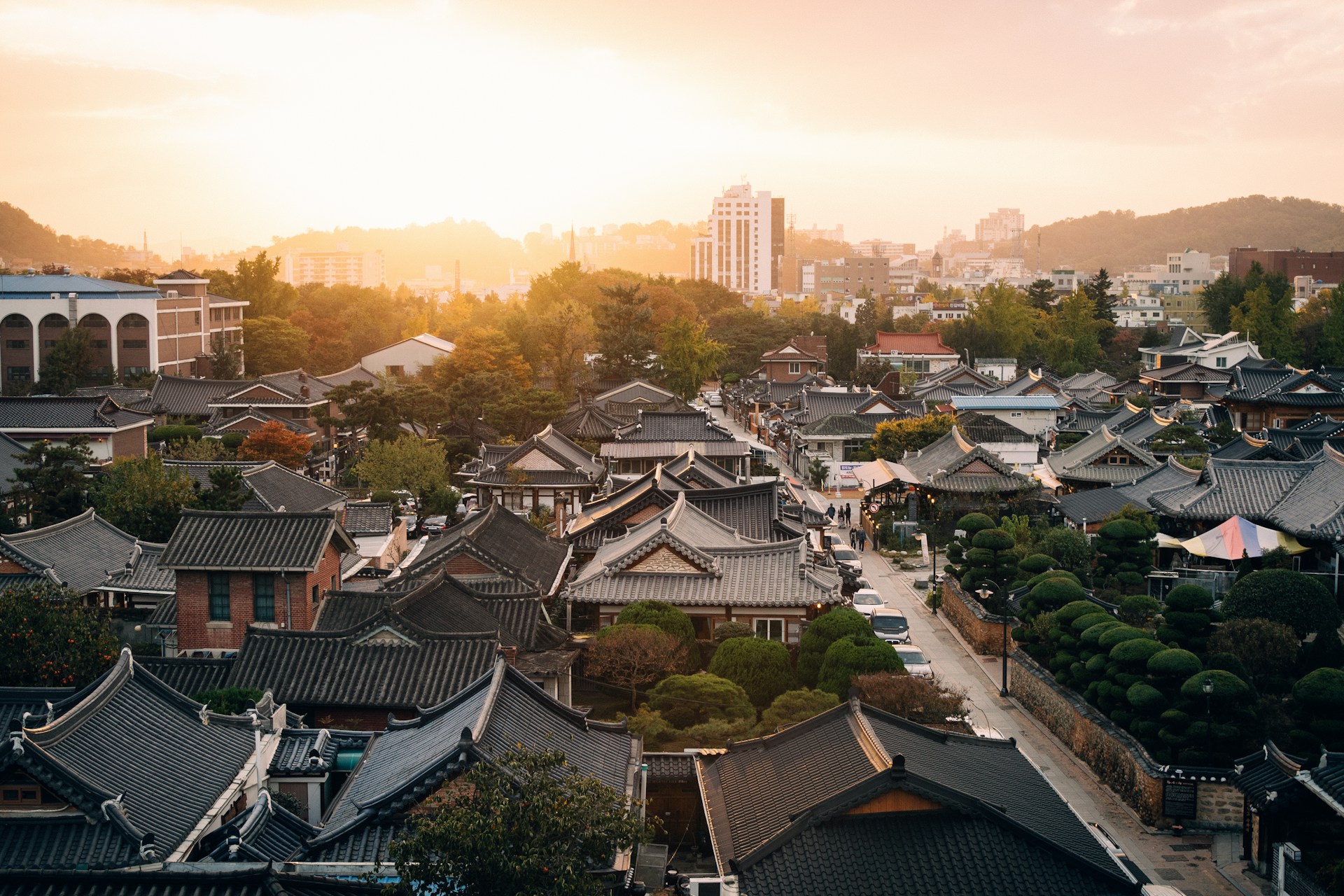
At the heart of Jeonju's tourism identity is Jeonju Hanok Village, the largest traditional hanok cluster in Korea, with over 700 traditional wooden hanok houses. The village has been officially designated an international Slow City, a status confirmed by both the KTO and Stripes Korea. Unlike other Korean cities where hanok buildings have been replaced by high-rise developments, Jeonju's Hanok Village has been deliberately preserved, making it one of the most intact windows into pre-modern Korean domestic architecture in existence. At night, the village is illuminated by cheongsa chorong, traditional Korean lanterns once used for royal banquets, transforming the atmosphere into what InsideAsia Tours describes as having the appearance of a film set.
Travel and Tour World's January 2026 feature on UK travel trends specifically named Jeonju and Daegu as cities gaining attention among international visitors for traditional food and cultural festivals, and noted Jeonju as a top favorite destination for UK travelers in 2026.
Jeonju is approximately 2 hours 40 minutes from Seoul Central City Terminal by express bus, and accessible by KTX high-speed train, Mugunghwa, and Saemaeul rail services, as confirmed by the Korea Tourism Organization. From Incheon Airport, a limousine bus takes approximately 3 hours 10 minutes to Jeonju Express Bus Terminal. The city is an ideal standalone destination or a two-night stop within a broader Korean itinerary that includes Seoul and Busan.
The Hanok Village is best explored on foot. Within the village, key heritage sites include Gyeonggijeon Shrine, which houses a portrait of King Taejo, the founding ruler of the Joseon Dynasty, set in a serene compound with a famous bamboo grove. Jeondong Catholic Church, built at the site where Korean Catholics were martyred during the Joseon period, offers an unexpected architectural contrast against the surrounding hanok streetscape. The Jeonju Traditional Liquor Museum and Jeonju Cinema Street, home of the Jeonju International Film Festival, are additional landmarks within walking distance.
Wearing hanbok, Korea's traditional attire, while walking through the Hanok Village is one of the most popular activities in Jeonju, documented by Stripes Korea as a major travel trend in Korea. Hanboknam, a well-known franchise with a branch in Jeonju Hanok Village, offers 2-hour rentals at approximately 10,000 to 20,000 won (prices as of Stripes Korea documentation, verify current rates on arrival). Staff assist with styling and accessories. Both traditional and modern hanbok styles are available.
Jeonju bibimbap, kongnamulgukbap (a bean sprout soup rice dish celebrated as a local hangover remedy), kalguksu (knife-cut noodle soup), and moju (a cinnamon-infused creamy rice beer unique to Jeonju) are the essential food experiences of the city, all documented by the Korea Tourism Organization. Street food throughout the Hanok Village includes cheese-filled bread, fried tornado potatoes, and fresh fruit juices. The local choco pie from PNB Pungnyeon Bakery inside the Hanok Village is one of the most recommended souvenirs.
The Jeonju International Film Festival takes place every spring (typically April to May), drawing global cinema audiences and providing one of the most culturally vibrant periods to visit the city. In autumn, the Jeonju Int'l Sori Festival attracts world music performers and audiences. Visit Korea recommends spring (April to June) for cherry blossoms or autumn (September to November) for food festivals and ideal walking weather.
Jeonju Hanok Village's international Slow City designation is not just a tourism label. It is a civic commitment by the city to preserve the pace, craft, and community of traditional Korean life against the pressures of rapid modernization. When visiting, eat at locally-owned carinderias and market restaurants rather than international chains that have begun appearing near the village perimeter. When renting hanbok, choose operators inside the village whose fees support the local economy rather than franchise operators located outside it. Participate in hands-on experiences such as traditional paper-making (hanji) workshops, pottery sessions, and makgeolli brewing classes: these are the activities that sustain the artisans whose presence makes the village worth visiting in the first place.
Kotor is a double-listed UNESCO World Heritage Site in Montenegro's fjord-like bay. Your fact-checked 2026 guide to the Adriatic's most layered medieval city and the rise of Western Balkans travel.
The Faroe Islands generated 1.4 billion DKK from tourism in 2025 while pioneering Europe's most innovative sustainable tourism model. Your fact-checked 2026 guide to the North Atlantic's most dramatic archipelago.
McMurdo Sound and the Ross Sea welcome only about 1,150 visitors per season. Your fact-checked 2026 guide to the world's most remote expedition and the huts of Scott and Shackleton.