Get consult
Unlock the secrets of the world’s most breathtaking locales with our expert insights — guiding you toward the truly remarkable destinations that define a lifetime of travel.



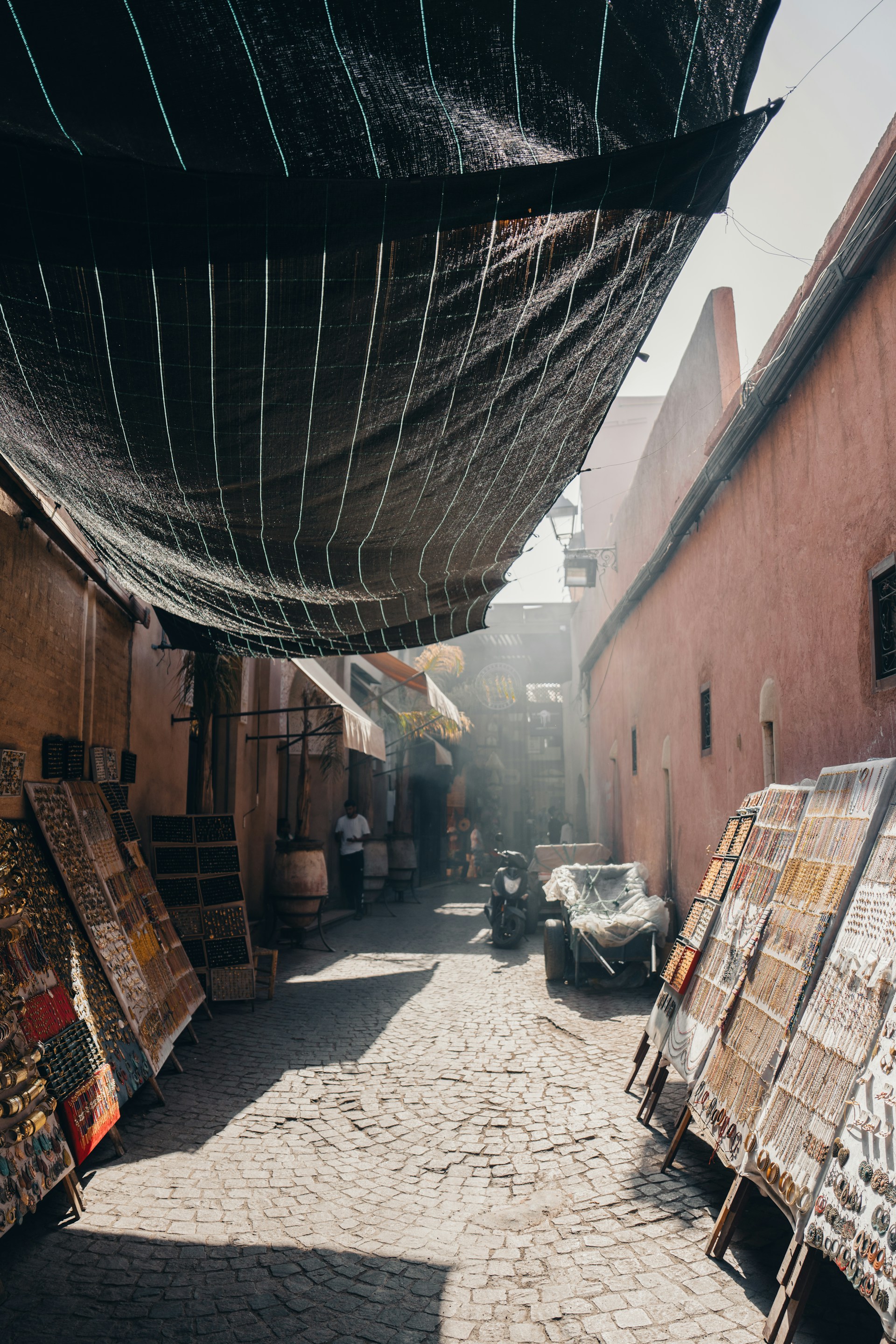
Photo by Peter Thomas on Unsplash
There is a particular kind of disorientation that happens the moment you step through the Clock Tower gate into Marrakech's medina for the first time. The street narrows. The light changes. A donkey cart forces you against a wall painted in that specific terracotta rose that gives Marrakech its name, the Red City. Somewhere in the labyrinth of alleys ahead, a metalworker is hammering brass into a tray. Two lanes over, a dyer is pulling bolts of saffron-yellow fabric from a stone vat. The smell of cumin and charcoal and cured leather arrives in layers. You have entered one of the oldest continuously inhabited urban spaces in the world, and it is fully, unapologetically alive.
In 2025, Morocco recorded its best tourism performance in history. Morocco welcomed approximately 19.8 million visitors in 2025, a 14 percent increase over 2024's record 17.4 million, with tourism receipts exceeding MAD 124 billion (approximately 13.4 billion USD) for the year, as confirmed by Morocco's Ministry of Tourism and reported by Tourism Reporter International citing official government data. Morocco's Q1 2026 performance continued this momentum: 4.3 million tourists arrived in the first quarter of 2026, a 7 percent rise over the same period in 2025, with March 2026 alone recording 1.6 million visitors, an 18 percent year-on-year increase, as confirmed by MICE Travel Advisor citing official Moroccan Ministry of Tourism data. Marrakech accounts for nearly 40 percent of all tourist overnight stays in Morocco, making it the country's undisputed primary destination, as confirmed by Travel Mole citing Morocco's Tourism Observatory data.
The trend reshaping Marrakech specifically in 2026 is Medina Immersion and the North African Craft Renaissance: a deepening traveler interest in the living artisan culture of the medina's souks, the intimate experience of staying in a traditional riad courtyard house, and the broader Amazigh and Islamic artistic heritage that the medina has preserved across nearly a thousand years. Marrakech in 2026 is not merely a backdrop for Instagram content. It is a destination where the most rewarding experiences require slowing down, getting lost, and engaging with a city that has been refining its crafts, its cuisine, its architecture, and its social rituals since the Almoravid dynasty laid its first foundations in 1062.
Marrakech was founded in 1062 by Almoravid sultan Abu Bakr ibn Umar, establishing it as the capital of a dynasty that would extend its reach from present-day Senegal to the Iberian Peninsula, as confirmed by the Marrakech Festival Heritage records and multiple historical sources. The city's name itself is believed to derive from the Amazigh words for land of God, a reflection of the deep Berber roots underlying every layer of Moroccan culture. Over the following nine centuries, Marrakech served as the capital of successive Moroccan dynasties: the Almoravids, the Almohads, the Merinids, the Saadians, and the Alaouites, each leaving architectural signatures that are still visible in the medina today.
The Koutoubia Mosque, built under the Almohad Caliph Yaqub al-Mansour in the 12th century, is the largest mosque in Marrakech and one of the most perfectly proportioned minarets in the Islamic world: its 70-meter tower served as the architectural model for the Giralda in Seville and the Hassan Tower in Rabat, as confirmed by multiple architectural history sources. The Ben Youssef Madrasa, a 14th-century Marinid Islamic school enlarged by the Saadians in the 16th century, contains some of the most intricate geometric stucco and carved cedar work in North Africa. The Saadian Tombs, built in the late 16th century under Sultan Ahmad al-Mansur and then sealed by the Alaouite dynasty for nearly 300 years, were only rediscovered in 1917 and house mausoleums decorated with carved marble, zellige tilework, and carved cedar ceilings of extraordinary quality, as documented by Moroccan Travel Trips' 2026 guide to Marrakech attractions.
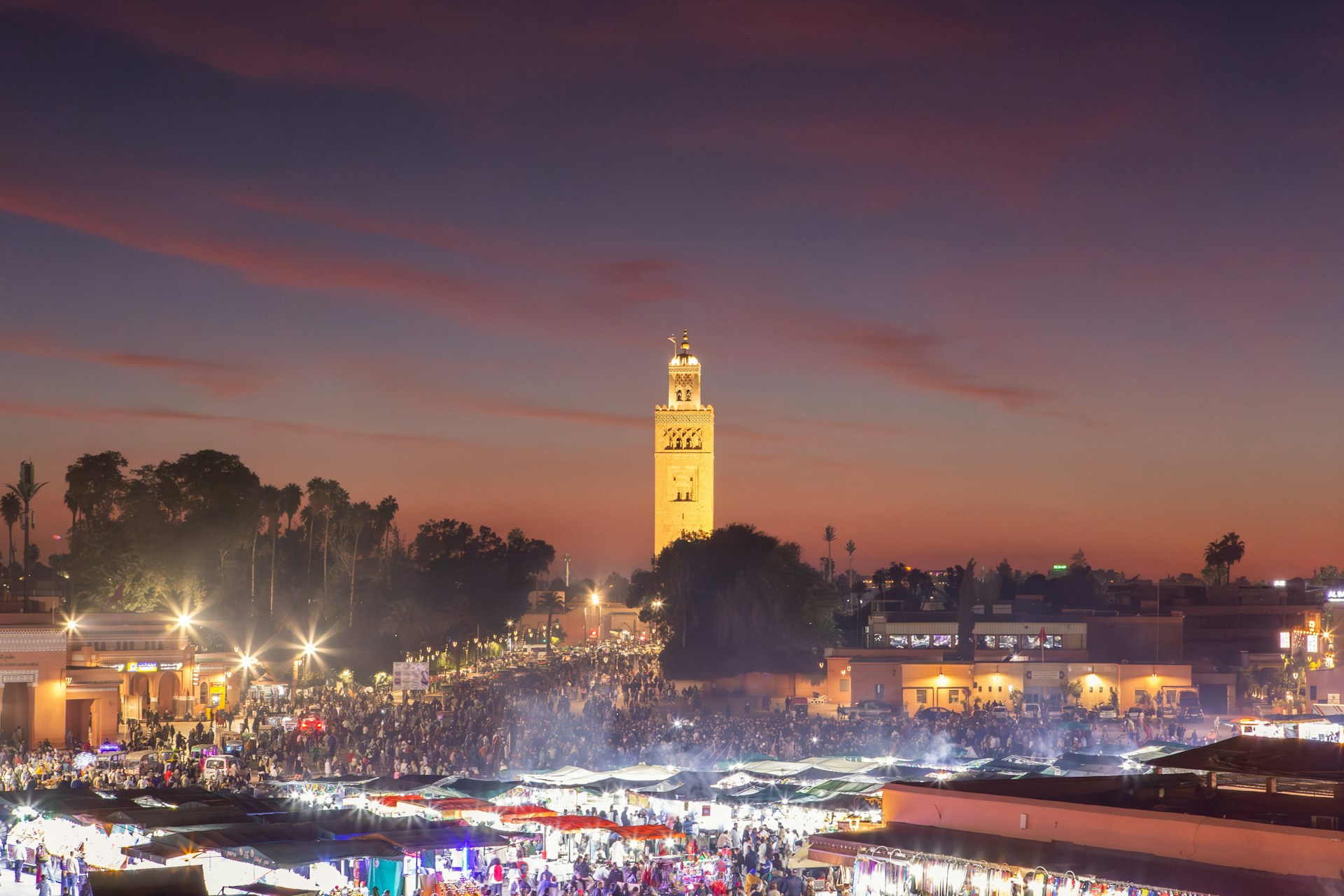
UNESCO inscribed the medina of Marrakech as a World Heritage Site in 1985, recognizing it as an outstanding example of a historic Moroccan city with more than 700 hectares of preserved urban fabric spanning souks, mosques, madrasas, palaces, and residential neighborhoods, as confirmed by The Marrakesher citing the UNESCO World Heritage Committee's official designation records. In 2001, UNESCO separately designated Jemaa el-Fna square as a Masterpiece of the Oral and Intangible Heritage of Humanity, the first cultural space in the world to receive this designation under UNESCO's intangible heritage framework, as confirmed by the Marrakech UNESCO Square Guide 2026. The square had evolved from its Almoravid-era origins as a site of public assembly and market activity into one of the most dynamic living performance spaces on earth, where storytellers, musicians, acrobats, dancers, and food vendors conduct a daily spectacle that has continued largely uninterrupted for centuries.
On September 8, 2023, a 6.8-magnitude earthquake struck the Al Haouz province southwest of Marrakech, causing significant damage across the city and the surrounding region. The medina sustained structural damage to historic buildings and private properties. Following the earthquake, the UNESCO World Heritage Committee conducted rapid assessments and confirmed the site's continued outstanding universal value while tracking ongoing preservation work. As part of the earthquake response, 76 demolition orders were revised to prioritize the protection of historic buildings, and the UrbanShift initiative in collaboration with Marrakech's Sustainable City program has shaped preservation strategies, as confirmed by The Marrakesher citing official UNESCO and municipal documentation. Morocco's tourism sector demonstrated remarkable resilience: 2024 arrivals surpassed 2019 pre-pandemic levels by 35 percent despite the 2023 earthquake impact, as confirmed by Travel Mole citing Morocco's Ministry of Tourism. The medina restoration work ongoing in 2025 and 2026 is a visible part of any visit and worth understanding: the city is investing in its own survival.
Two interrelated developments have transformed the traveler experience in Marrakech over the past two decades and are now at full maturity. The first is the riad hotel industry. A riad is a traditional Moroccan courtyard house, typically with thick earthen walls that keep interiors cool, a central courtyard garden or pool, and a rooftop terrace. Beginning in the early 2000s, a wave of restoration projects converted hundreds of crumbling medina riads into boutique guest houses, creating one of the most distinctive hospitality ecosystems in Africa. Today, a well-chosen riad inside the medina walls provides the most immersive and architecturally memorable accommodation experience available in any major African city. Budget appropriately: a reliable mid-range riad in 2026 requires at least 800 MAD per night for a double room, as confirmed by Morocco Unfolded's 2026 licensed Moroccan guide, with luxury riads and palace hotels ranging to several thousand MAD per night. The second is the revival of artisan craft culture. Morocco's Ministry of Handicrafts has invested significantly in souk infrastructure and artisan training programs over the past decade. The result is a medina souk circuit where genuine craftspeople, leather tanners, weavers, metalworkers, and woodcarvers operate alongside the tourism-facing market stalls, and where discerning travelers who walk past the first row of tourist merchandise often find the real creative culture a few turns deeper into the souk.
Marrakech Menara Airport (RAK) is the primary international gateway, handling direct flights from across Europe, the Gulf, and an expanding network of North American and African cities. Morocco added over 80 new flight routes in 2025 as part of its Tourism Roadmap 2023 to 2026, significantly improving air connectivity, as confirmed by Tourism Reporter International. Citizens of over 70 countries including the EU, United States, United Kingdom, Canada, and Australia enjoy visa-free entry to Morocco for stays up to 90 days, as confirmed by Tourism Reporter International citing Morocco's liberal visa regime documentation. Fly directly into Marrakech (RAK) rather than Casablanca unless significantly cheaper fares are available, as the Casablanca to Marrakech journey adds 3 hours by train or car, as confirmed by Civitatis' 2026 Marrakech travel guide. The Menara Airport is approximately 6 kilometers southwest of the medina. Official petit taxis (red for the city of Marrakech) and ride-hailing apps are available outside arrivals. Agree the taxi price before departure: the standard medina rate from the airport is approximately 100 to 150 MAD, as confirmed by Morocco Unfolded's guide.
The single most impactful accommodation decision in Marrakech is staying inside the medina in a riad rather than in a hotel in the Gueliz or Hivernage districts outside the walls. The sensory difference is total: a riad courtyard at midnight, with its lanterns, its tilework, its orange tree in the central garden, and its absolute silence broken only by the call to prayer, is an experience that no modern hotel can replicate. Choose a riad through a reputable booking platform and read recent reviews: quality varies significantly. Budget at least 800 MAD per night for a reliable double room in 2026, as confirmed by Morocco Unfolded. Use landmarks rather than GPS to navigate the medina: the labyrinth of unmarked alleys defeats digital maps repeatedly, and a riad's street address is almost always less useful than a hand-drawn map from the property itself, as confirmed by SkySkanner's April 2026 Marrakech practical guide. If you prefer modern amenities, large pools, and quieter streets, the Gueliz and Hivernage neighborhoods outside the walls offer conventional hotels and excellent restaurant scenes while still placing you 15 to 20 minutes from the medina by taxi.
Allow a minimum of two full days for the medina itself. The non-negotiable experiences are: Jemaa el-Fna in the late afternoon, when the square transitions from its daytime juice-vendor and acrobat mode into its extraordinary evening transformation with 200 food stalls, musicians, storytellers, and Gnawa musicians creating a sensory spectacle that has no equivalent in any other city in Africa. The souks radiating north from Jemaa el-Fna, organized loosely by craft: Souk Semmarine for textiles and clothing, Souk des Bijoutiers for silver and gold, Souk Chouari for woodworking, Souk Haddadine for blacksmithing, Souk des Teinturiers (the dyers' souk) for the most visually dramatic craft experience in the city, as documented by Marrakeche's medina guide. Ben Youssef Madrasa for the finest example of Moroccan Islamic architecture in the city, booking tickets in advance to avoid queues. Bahia Palace and Saadian Tombs, which can be combined in a single morning visit (they are close to each other), for the palaces and dynastic history. Jardin Majorelle, outside the medina walls in the Gueliz district, is the former botanical garden of French painter Jacques Majorelle, rescued from development in 1980 by Yves Saint Laurent and Pierre Bergé, and now containing the Berber Museum and the adjacent Musée Yves Saint Laurent, as documented by Moroccan Travel Trips' 2026 guide. Book Majorelle tickets online in advance: it is Marrakech's most visited paid attraction and queues without advance booking can exceed 90 minutes during peak season.
A traditional Moroccan hammam is a steam bath combined with exfoliation and massage, and it is the most intimate cultural experience available to a Marrakech visitor beyond the souks. Hammams exist on a spectrum from neighborhood hammams used by locals (typically 15 to 30 MAD, bring your own savon beldi black soap and kessa exfoliation mitt) to tourist-oriented hammams charging 200 to 500 MAD for a full traditional treatment. A mid-tier hammam experience through a well-reviewed riad or traditional hammam in the medina strikes the best balance between cultural authenticity and accessible quality. The experience typically involves a steam room session, full-body exfoliation with a kessa mitt, black soap application, and rinse, as documented by multiple 2026 Marrakech visitor guides. Hammams are gender-segregated with separate entrances and hours or separate facilities entirely: confirm with your chosen establishment before arrival. The cultural significance of the hammam as a communal social institution, not merely a spa service, is worth understanding before you go.
The best time to visit Marrakech is March through May and September through November, when temperatures are comfortable for walking (around 20 to 25 degrees Celsius), light is at its most beautiful for the terracotta medina walls, and crowds are manageable, as confirmed by SkySkanner's April 2026 Marrakech guide and Morocco Unfolded's licensed guide. Avoid July and August when temperatures regularly exceed 40 degrees Celsius and walking the medina becomes genuinely taxing. Budget ranges in 2026: budget travelers 40 to 60 USD per day, mid-range travelers 100 to 180 USD per day, luxury visitors 350 USD or more per day, as confirmed by SkySkanner's April 2026 pricing data. Currency is the Moroccan Dirham (MAD). The Dirham is a closed currency: it cannot be legally taken out of Morocco, so exchange or withdraw only what you need and spend it or exchange back before departure. ATMs are widely available in both the medina and Gueliz but carry cash for souk purchases and local restaurants, as Morocco street culture still relies heavily on cash transactions, as confirmed by Morocco's 2026 travel guide. Say no firmly: the standard phrase to decline unwanted guide services or merchant pressure in the souks is la shukran (no thank you in Arabic), which, delivered politely and without breaking stride, works reliably, as confirmed by SkySkanner's practical safety guide for Marrakech 2026.
Marrakech's medina is not a historical recreation. It is a living neighborhood of approximately 150,000 residents who navigate the same alleys as tourists every day, who send their children to school through the same souks where visitors are photographing pottery, and who have watched their city's character shift significantly under the pressure of mass tourism. The balance between preserving the medina's authenticity and managing tourist volumes is a genuine challenge that the city is actively navigating through UNESCO preservation frameworks, municipal restoration projects, and sustainable city programs.
Traveling responsibly in Marrakech means choosing locally owned riads over international hotel chains, purchasing directly from artisan craftspeople rather than from intermediary stalls that take large margins from the makers, and engaging with your guides and hosts as people rather than service providers. The Amazigh (Berber) cultural identity underlying so much of what makes Marrakech visually extraordinary, from the geometric tilework to the carved plaster to the woven textiles, belongs to a people whose cultural heritage has been dismissed and minimized for centuries. Visiting the Berber Museum within Jardin Majorelle, which traces Amazigh civilization across North Africa and the Sahara, provides essential context for understanding what you are actually looking at when you walk through the medina. The call to prayer you will hear five times daily from the Koutoubia minaret has marked the rhythms of this city for nine centuries. Entering mosques that are open to non-Muslim visitors with appropriate covering and quiet respect, and staying outside those that are not, is the minimum standard of conduct. Marrakech has survived invasions, earthquakes, dynasties, colonial occupation, and the pressures of modernity. Treat it accordingly.
Kotor is a double-listed UNESCO World Heritage Site in Montenegro's fjord-like bay. Your fact-checked 2026 guide to the Adriatic's most layered medieval city and the rise of Western Balkans travel.
The Faroe Islands generated 1.4 billion DKK from tourism in 2025 while pioneering Europe's most innovative sustainable tourism model. Your fact-checked 2026 guide to the North Atlantic's most dramatic archipelago.
McMurdo Sound and the Ross Sea welcome only about 1,150 visitors per season. Your fact-checked 2026 guide to the world's most remote expedition and the huts of Scott and Shackleton.