Get consult
Unlock the secrets of the world’s most breathtaking locales with our expert insights — guiding you toward the truly remarkable destinations that define a lifetime of travel.



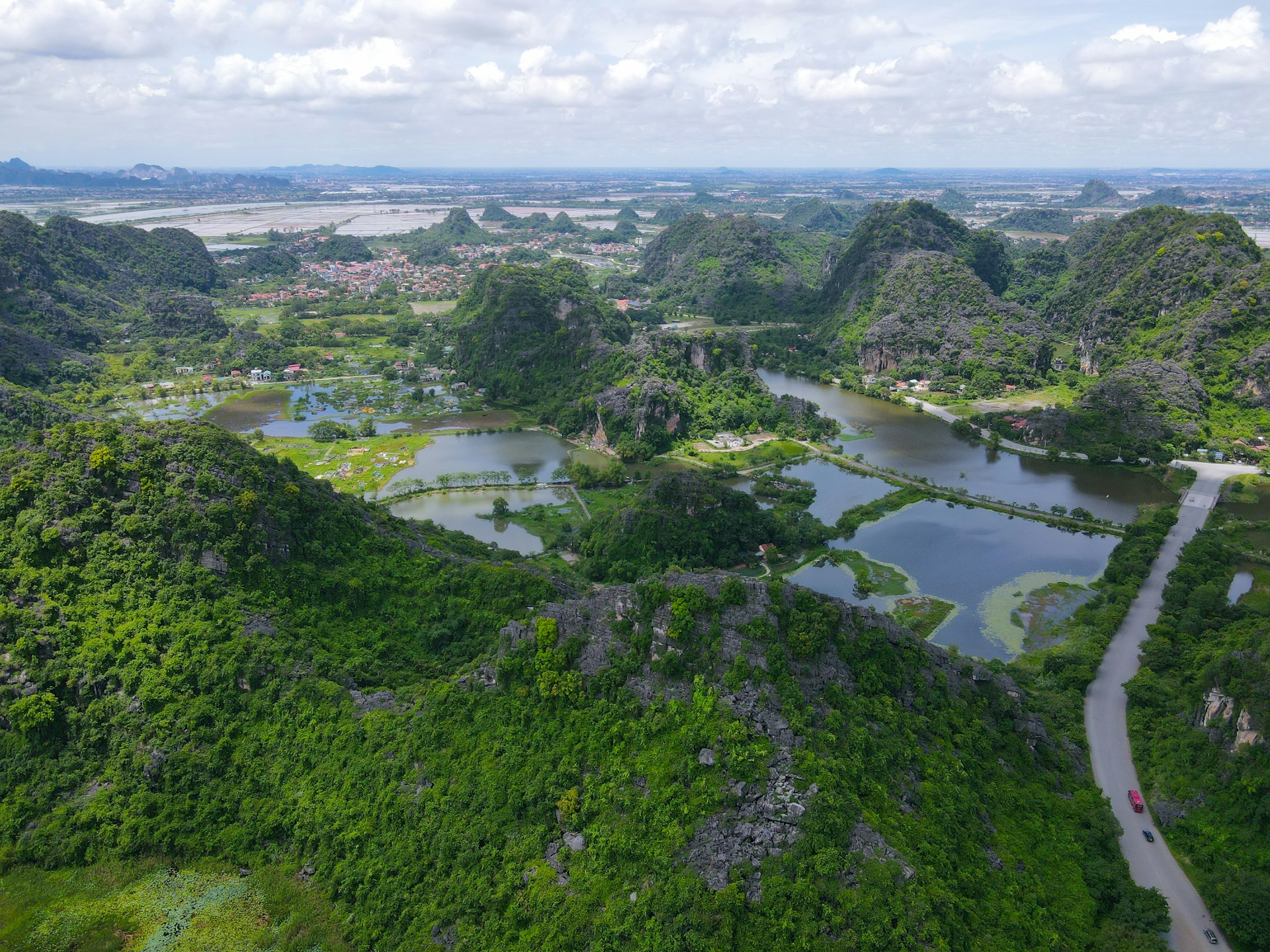
Photo by Florian Delée on Unsplash
There is a stretch of countryside roughly 90 kilometers south of Hanoi where the flat rice fields of the Red River Delta suddenly collide with a wall of ancient limestone. The karst peaks rise without warning from the valley floor, their green-draped flanks reflected in the slow rivers that wind between them, and the effect is so cinematically improbable that first-time visitors often stop mid-journey simply to absorb the fact that they are looking at a real landscape rather than a painting. The Vietnamese call it the Halong Bay on land. The world is beginning to agree.
In 2026, Ninh Binh is experiencing a visitor surge that has elevated it to the upper tier of Vietnam's national tourism story. In the first two months of 2026, Ninh Binh welcomed over 5.4 million visitors, a 9.9 percent increase year-on-year, generating nearly 5.84 trillion VND (approximately 221 million USD) in tourism revenue, a 15.9 percent increase, as confirmed by VietnamPlus (Vietnam News Agency). During the 2026 Lunar New Year holiday alone, the province received 2.38 million visitors, an 81.4 percent increase from the previous year, ranking second nationwide according to Vietnam's Ministry of Culture, Sports and Tourism, as reported by Visit Indochina Travel. In 2025, the province welcomed 19.4 million visitors including 2.2 million international arrivals, generating approximately 21.2 trillion VND in revenue, according to the Ninh Binh provincial Department of Tourism as cited by the Hong Kong Business Association Vietnam. The province has set a target of attracting 20 million visitors in 2026 as part of its long-term push toward a tourism revenue target of 45 trillion VND by 2030.
This momentum sits within a national story of record-breaking proportions. Vietnam welcomed nearly 21.2 million foreign arrivals in 2025, a 20.4 percent increase from 2024, surpassing the pre-pandemic 2019 record by 19 percent, as confirmed by VietnamPlus citing UN Tourism and Vietnam's national tourism data. Tourism revenue exceeded 1 quadrillion VND (approximately 38 billion USD), as documented by VOV (Voice of Vietnam). The trend driving Ninh Binh's specific rise within this boom is Heritage Eco Tourism: a deliberate choice by culturally motivated, environmentally conscious travelers to engage deeply with a destination where ancient imperial history, living Buddhist traditions, UNESCO-protected karst ecosystems, and community-based boat and cycling tourism are all available within a single day's reach of one of Asia's great capital cities. Vietnam's own Deputy Minister of Culture, Sports and Tourism, speaking at the VITM 2026 trade fair in April, cited Ninh Binh alongside Hoi An as one of two model destinations demonstrating that heritage preservation and sustainable growth are not in conflict.
Ninh Binh's significance in Vietnamese history is older and deeper than most international visitors realize. The city of Hoa Lu, located approximately 15 kilometers north of modern Ninh Binh town, served as Vietnam's first unified national capital from 968 to 1010 CE, under three consecutive dynasties: the Dinh (968 to 980), the Pre-Le (980 to 1009), and the Early Ly (1009 to 1010). Emperor Dinh Bo Linh, who unified the country's warring factions under the Dinh Dynasty after centuries of fragmentation and Chinese domination, chose this site strategically: the surrounding limestone mountains formed natural fortifications that made the valley almost impregnable to invasion, as documented by BestPrice Travel and Explore Ninh Binh. The ancient citadel complex spanned an estimated 3.5 square kilometers, as revealed by archaeological surveys conducted in 2024, significantly larger than previously estimated, as confirmed by Halong Bay Lux Cruises. In 1010, King Ly Thai To moved the capital north to Thang Long, the city that would eventually become modern Hanoi. Hoa Lu became the ancient capital, and time softened the citadel walls into the landscape. What remains are two celebrated temple complexes dedicated to King Dinh and King Le, set against limestone mountains and surrounded by rice fields and the Hoang Long River.
The pivotal modern turning point for Ninh Binh was June 23, 2014, when UNESCO inscribed the Trang An Scenic Landscape Complex on the World Heritage List, recognizing it as Vietnam's eighth UNESCO World Heritage Site and the only site in Southeast Asia recognized for both natural and cultural values simultaneously. The complex covers approximately 7,000 hectares and encompasses four interconnected areas: the Trang An Ecotourism Site, Tam Coc-Bich Dong, Hoa Lu Ancient Capital, and the Hoa Lu Special-Use Forest, as confirmed by North Vietnam Guide and the UNESCO designation records. The inscribed karst landscape contains 48 caves, river valleys, wetlands, and a dense limestone tower system that records 250 million years of geological evolution. Its cultural layer includes the remains of the Hoa Lu capital and evidence of human settlement spanning more than 30,000 years, as documented by multiple heritage sources.
The UNESCO inscription elevated Ninh Binh's international profile dramatically and catalyzed a shift in how the provincial government managed tourism. Boat operation restrictions were introduced in the Tam Coc-Bich Dong area to reduce environmental pressure, as documented by Travel and Tour World's 2025 sustainable tourism report. Cycling paths were expanded, including a newly completed cycling-only route alongside the Ngo Dong River that allows riders to avoid the main road entirely, added in 2025 as confirmed by Halong Bay Lux Cruises' cycling guide. New guided nature trail networks were developed at Van Long Nature Reserve and Cuc Phuong National Park, led by trained local community guides, as documented by Vietnam Paradise Travel's 2026 Ninh Binh guide. The provincial government framed Ninh Binh's entire development strategy around a model described by its tourism officials as placing cultural heritage at the centre, using traditional festivals to preserve its former imperial legacy while promoting sustainable tourism growth, as confirmed by VietnamPlus in April 2026.

One of the most structurally significant dimensions of Ninh Binh's modern tourism model is the direct connection between visitor spending and local community income. The boat rowers who take visitors through the river caves of Trang An and Tam Coc are local villagers who once depended entirely on farming. Many of the families in the villages surrounding the boat wharves now earn stable, fair incomes from tourism without leaving their communities or altering their way of life, as documented by EcoBnb's 2025 analysis of Ninh Binh as a model for eco-tourism. Each boat ride supports a local family directly, with revenue staying within the community rather than flowing to external operators or large corporations. This model, aligned with the global shift toward regenerative and community-based tourism documented by travel analysts including the World Travel and Tourism Council, is precisely what an increasingly large segment of international travelers is actively seeking in 2026.
Vietnam has significantly simplified its visa framework in recent years, making entry easier for the widest range of nationalities in the country's history. As of August 15, 2025, citizens of 12 additional European countries joined the existing list of nationalities enjoying 45-day visa-free entry to Vietnam, as confirmed by Wanderonless's 2026 Vietnam Visa Guide. Citizens of many Asian countries including Japan, South Korea, Singapore, Thailand, Malaysia, and others also qualify for varying durations of visa-free entry. For nationals not covered by exemptions, including US citizens, Vietnam's e-visa allows stays of up to 90 days (single or multiple entry) and costs 25 USD, as confirmed by Wanderonless. The e-visa is now accepted at 83 entry and exit points across Vietnam, up from 42 previously, including airports, land borders, and seaports, following a December 2025 expansion documented by Wanderonless. Apply online at the official Vietnamese government e-visa portal at evisa.gov.vn before travel. Always verify the current exemption status for your specific nationality at the official portal before booking, as the framework is subject to ongoing updates.
Ninh Binh is approximately 90 to 100 kilometers south of Hanoi and is accessible by three practical routes. The train from Hanoi Railway Station to Ninh Binh Station takes approximately 2 hours and 10 minutes, with tickets in the range of approximately 4 to 7 USD per person for a second-class air-conditioned seat, as confirmed by Vietnam Train Tickets Info (2026), North Vietnam Guide, and Bookaway. Trains depart multiple times daily and can be booked through Vietnam Railways' official website at dsvn.vn. This is consistently the most scenic and reliable option, as the route passes through flat delta farmland before the limestone peaks emerge dramatically from the horizon. The bus or limousine minivan from Hanoi's Old Quarter area takes approximately 2 to 2.5 hours, with many services running directly to the Tam Coc or Trang An visitor areas rather than Ninh Binh city center, as confirmed by North Vietnam Guide's 2025 guide to the Hanoi to Tam Coc route. A private car transfer via the expressway takes approximately 1.5 to 2 hours, as documented by Hanoi Explore Travel. Once in Ninh Binh, use Grab (Vietnam's dominant ride-hailing app) for short transfers between sites, or rent a bicycle from accommodation in the Tam Coc area for approximately 2 USD per day, as documented by Crazy Travelista.

Both Trang An and Tam Coc offer the iconic Ninh Binh experience of being rowed by a local boatman through cave-pierced limestone karst on a narrow river, but they offer distinct experiences. Trang An, located within the UNESCO core zone approximately 12 kilometers from Ninh Binh city center, features a longer circuit (approximately 3 hours), passes through more caves, includes temple stops within the waterway, and is consistently described by recent 2026 guides as the more atmospheric and less crowded option. It is the site most directly tied to the Hoa Lu ancient capital story. Tam Coc is shorter (approximately 2 hours), follows the scenic Ngo Dong River through three natural cave arches, and is surrounded by the most photogenic rice field scenery in the province. It is closer to the Hang Mua viewpoint and Bich Dong Pagoda, making it easier to combine multiple activities on a single day. Both sites charge a modest boat fee payable at the wharf, with the Tam Coc boat fee documented at approximately 270,000 VND per boat (maximum two people) in verified traveler accounts from Crazy Travelista, though fees should be confirmed on site as they are periodically revised.
Approximately 5 kilometers from Tam Coc, Hang Mua (Mua Cave) is a hillside complex where approximately 500 stone steps ascend steeply to two linked summits: Dragon Peak, crowned by a giant stone dragon overlooking the Tam Coc valley, and Pagoda Peak, a quieter alternative with equally sweeping views. The entrance fee is approximately 100,000 VND (roughly 4 USD), as confirmed by Crazy Travelista and Jonny Melon Adventure. The climb takes approximately 15 minutes of continuous ascent and is manageable for most visitors with moderate fitness, with handrails and rest points provided. The best time to visit is early morning around 6 AM before crowds arrive, or in the late afternoon for sunset views over the valley, as documented by Jonny Melon's 2026 Hang Mua guide. The view from the summit encompasses the Ngo Dong River, rice fields, and the limestone peaks that made Ninh Binh famous, and is widely described as the finest panorama in northern Vietnam. Visiting during the rice harvest season (May to June or September to October) offers the additional spectacle of golden fields replacing the usual deep green.
The optimal season for Ninh Binh is the dry season from November through April, when temperatures are cooler, skies are clearer, and conditions are ideal for boat tours, cycling, and the Hang Mua climb. The spring months of February and March add the dimension of Ninh Binh's traditional festivals, including the Truong Yen Festival at Hoa Lu Ancient Capital, a time of dragon processions on the river and traditional ceremonies that connect visitors directly to the region's imperial heritage, as documented by Explore Ninh Binh. The rice harvest windows of May to June and September to October offer spectacular golden-field scenery at the cost of warmer, occasionally wetter conditions. Most travelers find that two to three days in Ninh Binh is ideal: one day for the Trang An boat tour and Hoa Lu temples, one for Hang Mua, Tam Coc, and cycling the rice field paths, and a third for Van Long Nature Reserve or Cuc Phuong National Park for travelers seeking deeper immersion in the province's remarkable biodiversity.
Ninh Binh's status as a model for heritage eco-tourism is not incidental. It reflects deliberate choices by the local community and provincial government to build a tourism economy that preserves rather than consumes the landscape and culture that makes the province worth visiting. As a visitor, the most meaningful way to participate in that model is through the choices you make about how you spend and how you move.
Choose rowing boat tours over motorized alternatives wherever possible. In Trang An and Tam Coc, the traditional rowing boat is not a heritage performance: it is the actual livelihoods of the women and men who row them, families whose income from tourism has allowed them to remain in the villages their ancestors built within this extraordinary landscape. Rent a bicycle from your accommodation and use it rather than hiring a motorbike taxi for short transfers between sites: the flat roads around Tam Coc and the new cycling-only path alongside the Ngo Dong River make cycling both practical and genuinely pleasurable. Dress respectfully before entering the Hoa Lu temples, Bich Dong Pagoda, and any other religious site: shoulders and knees covered is the minimum standard of respect, and free shawls are available at most temple entrances for visitors who arrive unprepared. The Hoa Lu temples are active places of worship, not archaeological exhibits. The incense burning and offerings you observe there are genuine expressions of faith, not staging for photographs.
Eat and stay in locally owned establishments in the Tam Coc and Trang An village areas rather than tour-group restaurants on the main road. The difference in experience and impact is substantial: a family-run rice and goat meat restaurant or a riverside homestay contributes directly to the community that maintains this UNESCO landscape, while a large coach-catering operation does not. Ninh Binh's food is worth seeking out on its own terms: com chay (crispy rice cake), de nuong (grilled goat meat), and goi luon (eel salad) are local specialties that belong to the province's culinary identity and are available almost exclusively at local establishments.
Kotor is a double-listed UNESCO World Heritage Site in Montenegro's fjord-like bay. Your fact-checked 2026 guide to the Adriatic's most layered medieval city and the rise of Western Balkans travel.
The Faroe Islands generated 1.4 billion DKK from tourism in 2025 while pioneering Europe's most innovative sustainable tourism model. Your fact-checked 2026 guide to the North Atlantic's most dramatic archipelago.
McMurdo Sound and the Ross Sea welcome only about 1,150 visitors per season. Your fact-checked 2026 guide to the world's most remote expedition and the huts of Scott and Shackleton.