Get consult
Unlock the secrets of the world’s most breathtaking locales with our expert insights — guiding you toward the truly remarkable destinations that define a lifetime of travel.



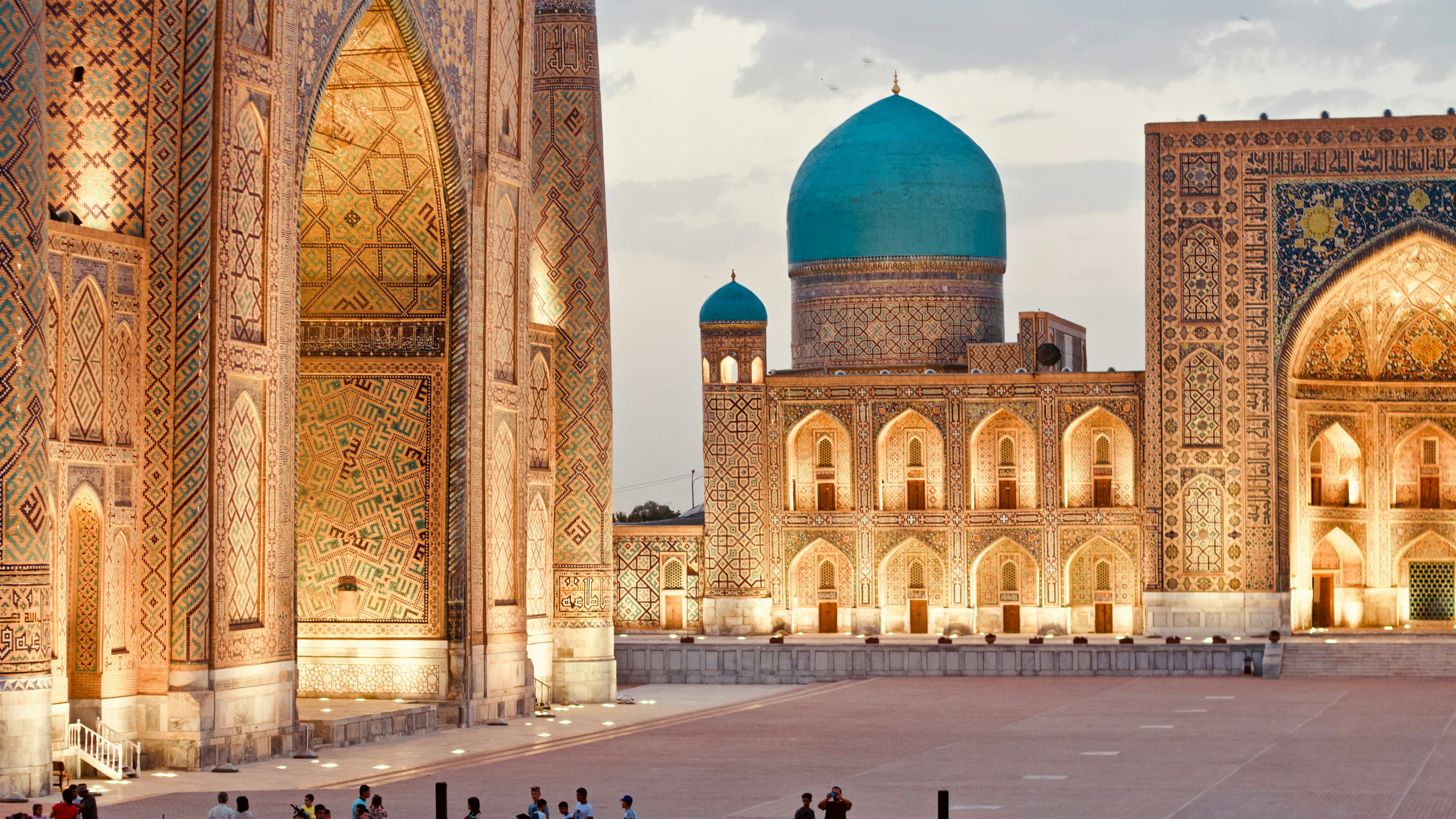
Photo by Ozodbek Erkinov on Unsplash
There is a moment that every traveler to Samarkand describes in almost identical terms regardless of where they come from. It happens when they step through the gateway of the Registan for the first time and the three great madrasahs fill their entire field of vision, tiled in lapis and gold, their proportions so precisely balanced that the square itself feels designed to produce a particular sensation in the human body. Awe is too small a word for it. The British poet James Elroy Flecker called Samarkand the city whose fame the golden journey to must honor, and in 2026, millions of travelers are proving him right by booking flights.
Uzbekistan ended 2025 with nearly 12 million international visitors, a 16 percent jump from the previous year, with tourism exports exceeding 4.8 billion USD, according to Travel and Tour World. The country was ranked among the seven fastest-growing tourism destinations in the world between January and September 2025 by the UN World Tourism Organization, with international arrivals up 73 percent compared to 2019 levels, as confirmed by Euronews in December 2025. In the first two months of 2026 alone, Uzbekistan welcomed 1.77 million visitors, a 33 percent increase over the same period in 2025.
At the center of this surge sits Samarkand, the Pearl of the Silk Road, a city founded in the 7th century BC that served as capital of the Timurid Empire, intellectual hub of the medieval Islamic world, and now the most compelling new entry point into a regional tourism boom that is only just beginning. The modern trend Samarkand leads in 2026 is Heritage Luxury Tourism: the convergence of world-class Islamic architecture, new five-star international hotel infrastructure, a liberalized visa policy, and the opening of a high-speed rail network that has transformed the entire Golden Triangle of Uzbek cities into a single seamless itinerary.
Samarkand has always been historically significant. What has changed in the last two to three years is everything around it: the infrastructure, the accessibility, and the international recognition that turns historical significance into actual visitor demand.
Until 2018, visiting Uzbekistan required a bureaucratic gauntlet that deterred all but the most committed travelers. The transformation since then has been dramatic. By 2025, citizens of 94 countries could enter Uzbekistan visa-free, while 52 additional nations had access to an efficient electronic visa system, as confirmed by Travel and Tour World. For travelers who previously associated Central Asia with impenetrable borders and Soviet-era paperwork, this open-door policy has been genuinely transformative. The US market alone recorded 28,600 visitors between January and September 2025, a 22.4 percent year-on-year increase, according to Euronews.
The Afrosiyob high-speed train connecting Tashkent, Samarkand, and Bukhara has become a tourism attraction in its own right. Travelers who once faced long, disorienting bus journeys through the desert can now cover the full Golden Triangle in European-style comfort within a matter of hours. The Tashkent to Samarkand leg takes approximately two hours. The train departs multiple times daily and has made the multi-city Uzbekistan itinerary not just possible but genuinely enjoyable. Travel and Tour World noted in January 2026 that the ability to traverse centuries of history in a matter of hours has changed the reputation of desert travel from exhausting to luxurious.
The 2025 data revealed what Travel and Tour World described as a bottleneck: hotels in Samarkand hit 95 percent occupancy during spring and autumn peaks, driving a new wave of hotel construction. In 2025 alone, approximately 1.4 billion euros in tourism investments were implemented across 421 projects across Uzbekistan, including new five-star hotels under international brands such as JW Marriott, Swissôtel, DoubleTree by Hilton, and Azimut, as confirmed by Euronews. The Samarkand Silk Road Resort, a large complex of hotels, congress centers, and recreation zones, has established that Uzbekistan can handle significant visitor volume without compromising the character of its historic sites. By early 2026, Uzbekistan had 6,921 total accommodation facilities with a combined capacity of approximately 185,600 places, according to Travel and Tour World.
At the geographic and spiritual heart of Samarkand sits the Registan, the most iconic architectural ensemble in Central Asia and one of the most celebrated public spaces on earth. Three madrasahs frame three sides of the square: the Ulugh Beg Madrasah on the left, built in the 15th century and featuring the earliest surviving astronomical motifs in Islamic architecture; the Sher-Dor Madrasah on the right, with its tiger mosaic above the entrance arch that controversially depicted living creatures in violation of Islamic artistic convention; and the Tilya-Kori Madrasah in the center, whose interior mosque is covered in a gold leaf ceiling so dense it appears to glow from within. Multiple global travel authorities recognized Registan Square in 2025 as one of the most beautiful places in the world, as confirmed by Euronews citing the UN Tourism assessment.
The Registan opens at 8:00 AM daily. Arriving at opening time is the single most effective strategy for experiencing it without the tour groups that arrive mid-morning. After dark, the square is illuminated by a light show synchronized to music, projected onto the facade of all three madrasahs, producing an experience that travelers consistently describe as the finest architectural light show they have ever seen.
Shah-i-Zinda, meaning The Living King, is a necropolis of mausoleums lining a narrow ceremonial avenue. Where the Registan dazzles with scale and symmetry, Shah-i-Zinda overwhelms with intimacy: the tiled facades are close enough to touch, the blues so saturated they appear almost unnatural, and the complex continues to function as an active pilgrimage site. Multiple experienced Samarkand visitors describe it as the city's most emotionally affecting monument, surpassing even Registan in personal impact.
The Gur-e-Amir Mausoleum, built in 1404, is the final resting place of Amir Timur (Tamerlane) and serves as the direct architectural ancestor of the Taj Mahal. Its ribbed azure dome, its courtyard of four minarets, and its interior covered in gold leaf and lapis lazuli tiles represent the prototype from which Mughal funerary architecture drew its entire visual vocabulary. Entrance fees are affordable and the mausoleum is approximately 10 minutes on foot from Registan Square. The card payment system at some sites can be unreliable: bringing local currency (Uzbek som) is advisable.
The Ulugh Beg Observatory, located slightly outside the city center by taxi, preserves the remains of a 15th-century astronomical instrument of extraordinary accuracy. Ulugh Beg, grandson of Timur and one of the great scientific minds of the medieval Islamic world, used this observatory to calculate the length of the stellar year to within one minute of its actual value, without the aid of a telescope. The museum on site provides context for why Samarkand was not just a center of architectural beauty but of genuine intellectual civilization.
Samarkand has its own international airport, Samarkand International Airport (SKD), with direct connections from Istanbul, Dubai, Moscow, and several other regional hubs, making it possible to skip Tashkent entirely for travelers entering from Western or Gulf markets. For those arriving into Tashkent, the Afrosiyob high-speed train covers the approximately 350-kilometer journey to Samarkand in roughly two hours, departing multiple times daily. Upon arriving at Samarkand railway station, the historic center and Registan Square are approximately a 20-minute taxi ride. Use the Yandex Go app for fair, metered fares rather than accepting quotes from the taxi operators outside the station, which are consistently reported by travelers as significantly inflated.
Citizens of 94 countries can enter Uzbekistan visa-free as of 2025. For the 52 additional nations requiring a visa, an e-visa is available through the official Uzbekistan government portal (e-visa.uz). Application processing typically takes several days. Always verify the current policy for your specific nationality at the official portal before booking, as the list of eligible countries continues to expand and requirements can change.
The optimal travel window for Samarkand is April through May and September through October, when temperatures are mild and range from approximately 20 to 28 degrees Celsius, skies are clear, and the city's gardens and tree-lined boulevards are at their most inviting. Spring also coincides with Navruz, the Persian New Year celebrated in March, a period of significant cultural activity across Uzbekistan. Summer temperatures regularly exceed 40 degrees Celsius and make outdoor sightseeing genuinely demanding. Winter months offer the quietest experience but with cold temperatures and reduced hours at some sites.
Samarkand's historic center is pedestrian-friendly. The walk from Registan Square to Gur-e-Amir takes approximately 10 to 15 minutes, and most major sites are within comfortable walking distance of one another. The Siyob Bazaar, one of the best open-air markets in Central Asia for ceramics, silk, suzani embroideries, and fresh produce, is a short walk from the Bibi Khanym Mosque. Invest in a licensed local guide for at least one day: the historical context these guides provide transforms what are already extraordinary monuments into genuinely instructive encounters with one of civilization's most remarkable chapters. The entrance fee for the Registan is approximately 50,000 UZS (roughly USD 4 to 5 at 2025 exchange rates), and most major sites charge similarly modest fees. Bring cash in Uzbek som as card readers at smaller sites and in bazaars are not always reliable.
Samarkand's cuisine is built around plov, the Uzbek national dish: a slow-cooked rice preparation with lamb, carrots, and onion made in a massive kazan (cast iron cauldron) over open flame. Samarkand plov has its own regional variation, lighter in color and distinctly different from the Tashkent version. The best plov in the city is found at established local restaurants and market eateries rather than at tourist-facing establishments adjacent to the main monuments. Shashlik (grilled meat skewers), somsa (baked meat pastries), and freshly baked non bread are standard Uzbek staples available throughout the city. Several restaurants near the Registan offer rooftop or courtyard dining with views of the illuminated madrasahs in the evening.
Samarkand's rise to global tourism attention brings with it a responsibility that is easy to overlook when surrounded by monuments of such grandeur. The artisan traditions that have defined this city for centuries, including silk weaving, ceramic production, and the unique Samarkand paper-making craft revived from medieval recipes, are sustained by individual families and workshops, not by the large hotels or souvenir chains near the main squares. When buying ceramics, textiles, or other crafts, seek out the workshops in the residential mahallas (neighborhoods) beyond the immediate tourist corridor. The Samarkand Paper Workshop, which produces handmade paper using a technique dating to the 8th century when Samarkand was the paper-making capital of the medieval world, is one of the most remarkable craft experiences in Central Asia and purchases there directly support the continuity of this tradition. The act of choosing a local guesthouse over a chain hotel, eating at a family-run teahouse rather than a tourist restaurant, and learning even a few words of Uzbek or Russian before arriving transforms the experience from observation to genuine exchange. Samarkand's hospitality is not a service industry: it is a cultural identity that predates the concept of tourism by more than a thousand years.
Kotor is a double-listed UNESCO World Heritage Site in Montenegro's fjord-like bay. Your fact-checked 2026 guide to the Adriatic's most layered medieval city and the rise of Western Balkans travel.
The Faroe Islands generated 1.4 billion DKK from tourism in 2025 while pioneering Europe's most innovative sustainable tourism model. Your fact-checked 2026 guide to the North Atlantic's most dramatic archipelago.
McMurdo Sound and the Ross Sea welcome only about 1,150 visitors per season. Your fact-checked 2026 guide to the world's most remote expedition and the huts of Scott and Shackleton.